About Mussa angulosa (Pallas, 1766)
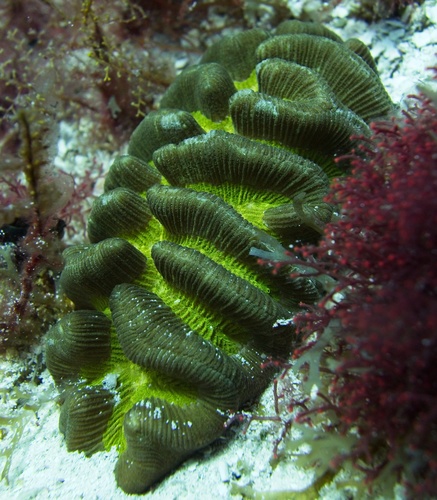
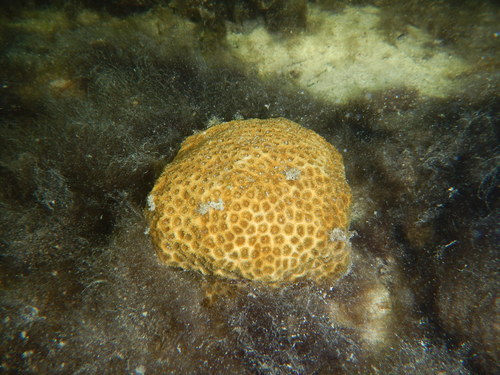
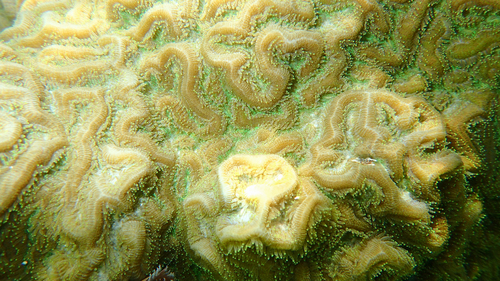
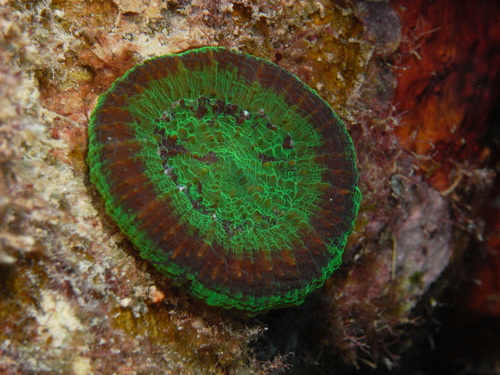
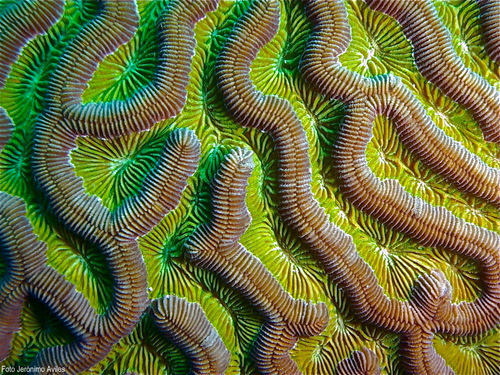
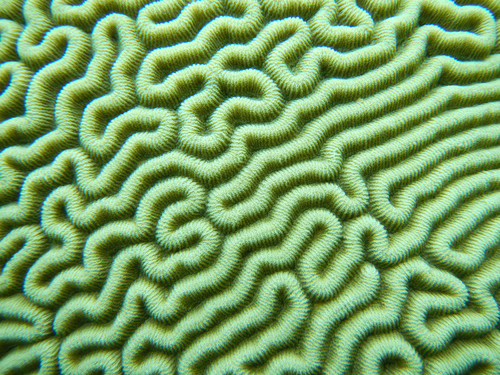
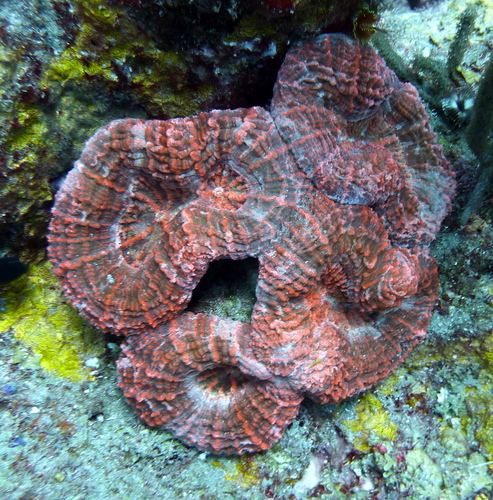
Mussa angulosa (Pallas, 1766) is a colonial stony coral species. Whole colonies grow into low dome-shaped clumps that can reach 50 centimetres (20 in) across. Its corallites are phaceloid, meaning they grow in a tubular shape from a shared base, typically in series of one to three, and occasionally up to five. Individual corallites are large, with diameters between 25 to 45 mm (1.0 to 1.8 in) and heights up to 6 mm (0.2 in). Each corallite has four cycles of septa that are nearly equal in size; the septa are narrow, curved, and widely spaced. The individual polyps of Mussa angulosa are very large, sometimes growing to 12 centimetres (4.7 in) long and 4 centimetres (1.6 in) in diameter. These large polyps completely cover the short branches of the coral’s stony skeleton. During the day, the polyps have a fleshy appearance, while at night they expand further, and each polyp is edged with a rim of short tentacles. Polour colour is variable, ranging from grey or pale brown with additional green, pink, and purple tones. The tissues of this coral host symbiotic single-celled algae called zooxanthellae. These algae are photosynthetic, and they absorb energy from sunlight to produce organic compounds that the coral uses. Mussa angulosa is distributed in the Caribbean Sea, the Gulf of Mexico, and the Bahamas, and also occurs on reefs and banks off the coast of Texas and southern Florida. It grows in water between 3 and 60 metres (10 and 197 ft) deep, and is most commonly found at depths between 10 and 30 metres (33 and 98 ft).