About Musophaga rossae Gould, 1852
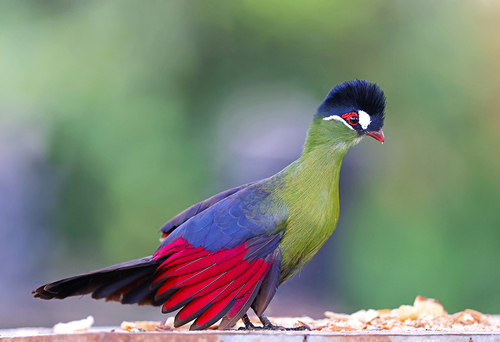
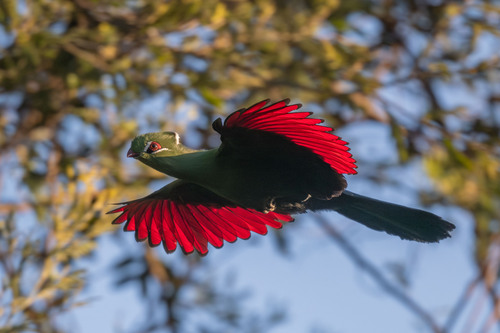
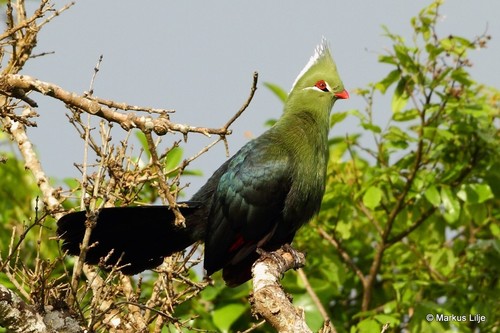
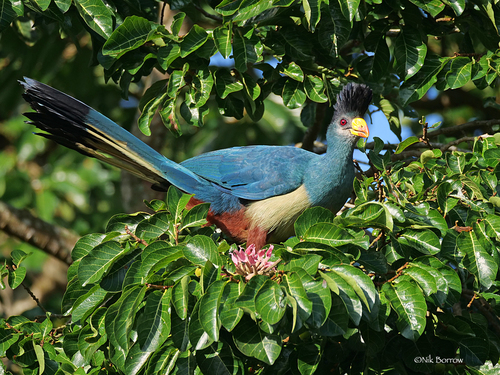
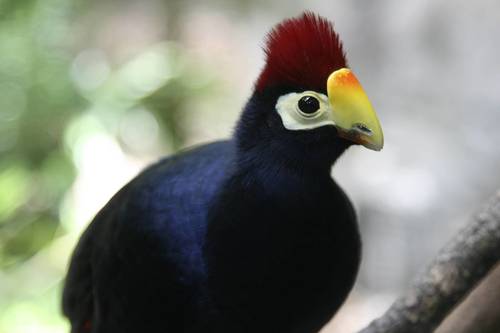
Musophaga rossae (commonly known as Ross's turaco) shows very little sexual dimorphism: both males and females have the same deep blue plumage, along with red crowns and red flight feathers. Female beaks are often slightly more yellow-green, while male beaks are always bright yellow; both sexes have a forehead shield that flares to a medium orange. This species has short, round wings, suited for short bursts of powered flight. Their legs are black, with three toes facing forward and a fourth semi-zygodactylous toe, an adaptation that makes them nimble canopy dwellers. Adult individuals range from 15 to 18 inches in length and weigh just under one pound. Ross's turaco are sturdy birds, with reported lifespans ranging from 8 to 20 years across different sources. This species is primarily found in woodlands, open forest, and riparian habitats across Angola, Botswana, Burundi, Cameroon, the Central African Republic, the Democratic Republic of the Congo, Gabon, Kenya, Rwanda, South Sudan, Tanzania, Uganda, and Zambia. They generally avoid densely forested areas. They are non-migratory and rarely travel far from their birthplace, though they will move if food is scarce in their local area. Despite threats from agricultural expansion causing habitat destruction, their population remains stable. Ross's turaco form monogamous breeding pairs that share incubation and feeding responsibilities. Pairs lay 2 to 3 eggs, which hatch after approximately 25 days of incubation. Young birds spend another 4 to 7 weeks in the nest with their parents before fledging. Unusually, young Ross's turaco become mostly independent before they are able to fly, and instead climb through the forest canopy. They reach sexual maturity at one year of age, and typically stay near their parents in extended family flocks that can number up to thirty individuals. Flock members often help raise other flock members' chicks, particularly when the mother is breeding for the first time. This species becomes more territorial during the brooding season, especially toward predatory or unfamiliar birds.