About Muscisaxicola maclovianus (Garnot, 1826)
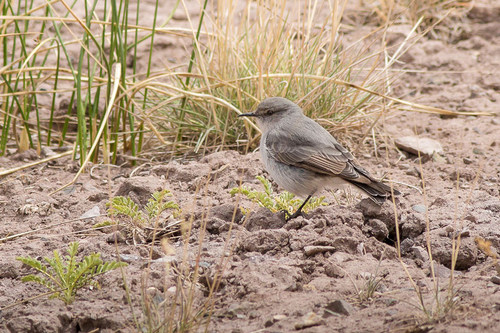
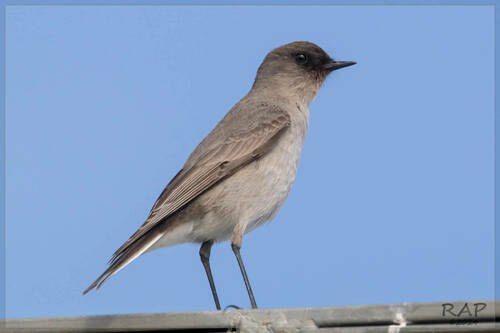
The dark-faced ground tyrant, Muscisaxicola maclovianus, measures 15 to 16.5 cm (5.9 to 6.5 in) in length. Both its two subspecies and both sexes share identical plumage, though the subspecies M. m. mentalis is significantly smaller than the nominate subspecies. Adult dark-faced ground tyrants have blackish foreheads, lores, and cheeks, paired with a dull chestnut-brown crown. Their upperparts are mostly dark brown to smoky brown, with a black lower rump. Their wings are a duskier brown than their upperparts, while their tail is black with whitish edges along the outer webs of the outermost feathers. Their throat and breast are gray, and their belly and crissum are white. They have a dark iris, a short black bill, and black legs and feet. Juveniles have a streaky throat and buffy edges on their wing coverts. The nominate subspecies occurs only on the Falkland Islands. Subspecies M. m. mentalis ranges from southern Ancash Department in west-central Peru, south through the full length of Chile. Its range extends across Argentina roughly from San Juan Province (and possibly further north) east to Entre Ríos Province, across southern Uruguay, and south from this area all the way to Cape Horn. This species has been recorded as a vagrant in southern Brazil and on South Georgia Island. Unconfirmed sight records from Ecuador have led the South American Classification Committee of the American Ornithological Society to list the species as hypothetical there. During the breeding season, the dark-faced ground tyrant lives in open grasslands located near forest or rivers, as well as in marshy valley areas. In the non-breeding season, it inhabits grasslands and pastures, and also uses irrigated fields, sandy desert, and beaches; on beaches, it is sometimes seen on dried or floating seaweed. Different sources report different maximum elevation limits for the species: one notes a usual upper limit of 1,200 m (3,900 ft), with rare visits up to 2,500 m (8,200 ft); a second states an upper limit of 1,500 m (4,900 ft); a third reports that the species reaches 4,000 m (13,000 ft) only rarely in Peru.