About Muscina stabulans (Fallén, 1817)
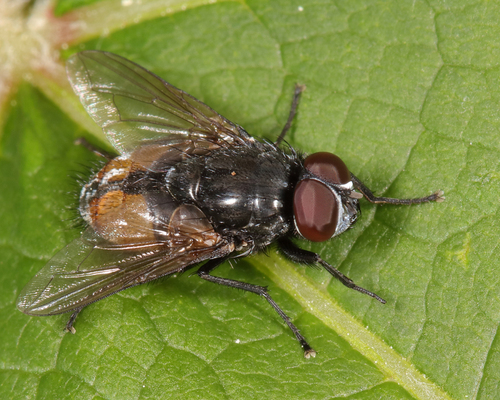
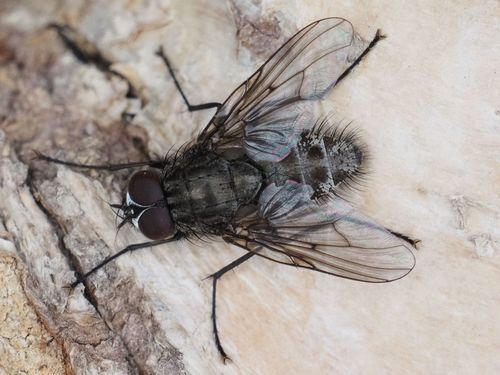
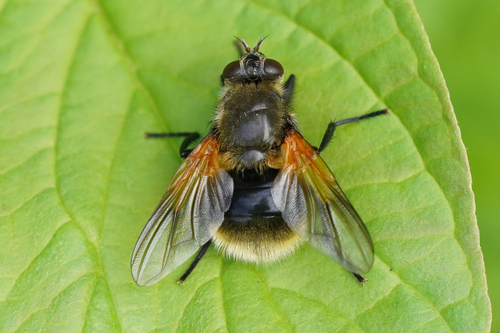
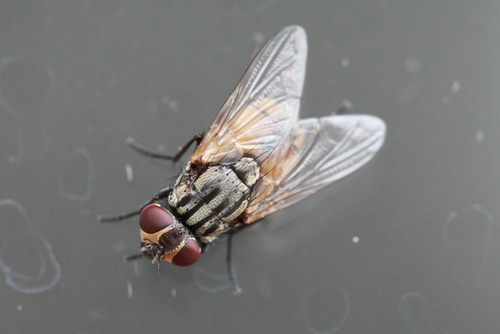
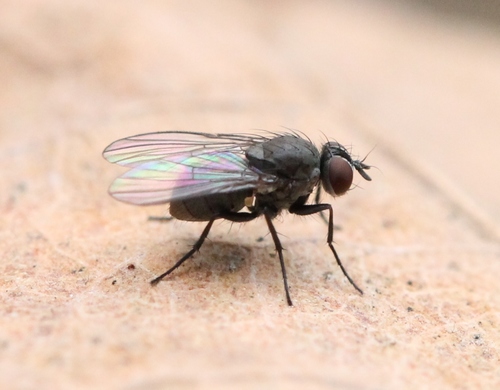
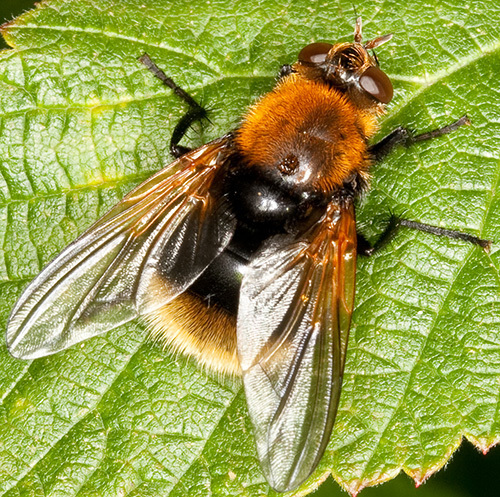
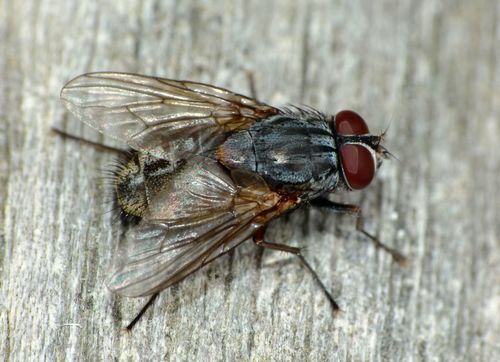
Adult Muscina stabulans have partially reddish-brown legs, four characteristic dark stripes along the thorax, and a pale spot above the thorax. Adults average 8 millimeters (0.3 inches) in length. Their abdomen is either entirely black, or black with red sides. Their head ranges in color from dark-grey to a whitish hue. In the posterior area, circular spiracular plates are separated by roughly the width of one plate. Larvae are dull white, 6–7 mm long and 1–1.5 mm wide. They have 11 segments; all segments except the last have a belt of small, well-developed spines oriented toward the posterior margins. The pseudo-cephalic segment has two hooks, and the posterior spiracles have curved spiracular slits. In a study of synanthropy (ecological association with humans) of adult Muscidae collected across urban, rural, and natural environments in Valdivia, Chile, this species, commonly called the false stable fly, was found mostly in rural and natural areas, and only rarely in cities. Muscina species as a whole are distributed widely throughout the United States. Muscina stabulans is active year-round for the most part, but its activity peaks during the summer months, when the number of its generation cycles also peaks. Its overall habitat is similar to that of the house fly, Musca domestica. False stable flies have been observed in animal housing including poultry houses, in the mucosal linings of mammalian intestines, and on carrion at all decomposition stages. They show a strong preference for later stages of decomposition, and can reach buried bodies in shallow ground by moving through several inches of dirt.