About Muscicapa sibirica Gmelin, 1789
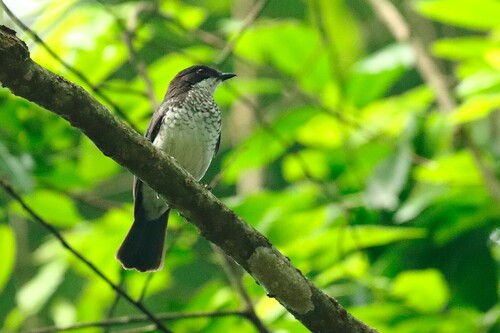
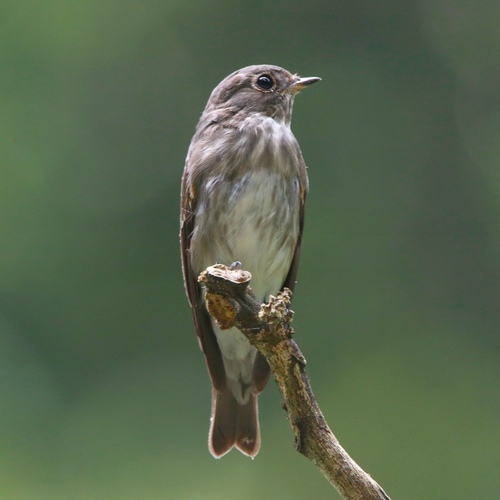
This species, the dark-sided flycatcher, has a scientific name of Muscicapa sibirica Gmelin, 1789. The overall body length of the dark-sided flycatcher ranges from 13 to 14 cm (5.1 to 5.5 in). Its upperparts are plain dark grey-brown, with the exception of a pale wingbar and pale edging on the tertial feathers. The breast and flanks have a variable amount of streaky dark grey-brown markings. A pale submoustachial stripe and a dark malar stripe outline the white throat and half-collar. The center of the lower breast and belly is white, while the undertail-coverts are white with dark-colored feather centers. It has a short, dark bill, black feet, a large eye surrounded by a whitish ring. Adult individuals of both sexes have identical plumage, but juveniles have pale spots on the upperparts, a mottled breast, and buff-colored tips on the wing-coverts. The dark-sided flycatcher can be distinguished from the similar Asian brown flycatcher (Muscicapa dauurica), which has relatively plain pale underparts, and from the grey-streaked flycatcher (Muscicapa griseisticta), which is white below with distinct grey streaks. Dark-sided flycatchers also have a longer primary projection on their wings than Asian brown flycatchers. The dark-sided flycatcher's song is a sequence of thin, high-pitched notes that includes trills and whistles, while its call is a metallic tinkling sound. Three recognized subspecies have defined breeding ranges, and one additional subspecies has a distinct range: M. s. sibirica breeds in southeast Siberia westward to beyond Lake Baikal, as well as in Mongolia, northeast China, North Korea, and Japan (Hokkaidō and northern Honshū); M. s. rothschildi breeds in western China and Myanmar; M. s. gulmergi occurs from Afghanistan to Kashmir; and M. s. cacabata ranges from the eastern Himalayas to southeast Tibet, and possibly also Myanmar. This species' wintering range covers northeast India, Bangladesh, southern China, Taiwan, and Southeast Asia as far south as Sumatra, Java, Borneo, and the Philippines (Palawan and Culion). Vagrant dark-sided flycatchers have been recorded in Alaska, Iceland, and Bermuda. The species inhabits coniferous and mixed forest and woodland, and is sometimes found in plantations, parks, and gardens. It typically lives in mountainous regions, and can be found up to 4000 metres above sea level in some areas.