About Musca domestica Linnaeus, 1758
Scientific name: Musca domestica Linnaeus, 1758
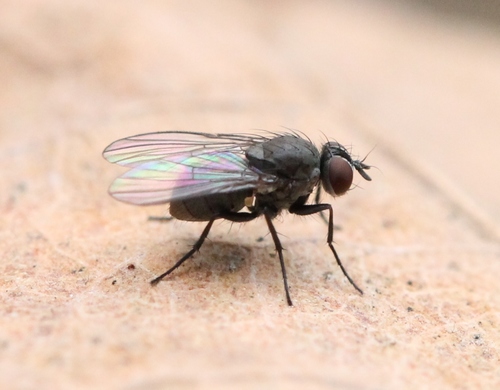
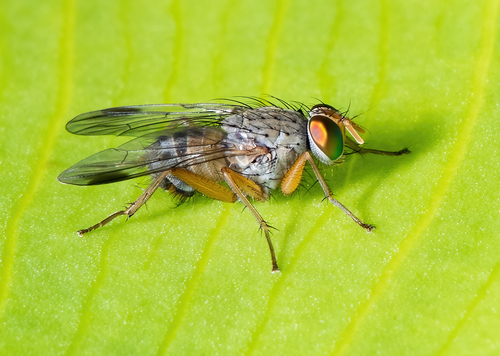
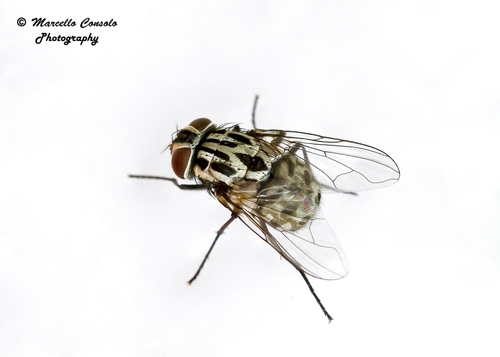
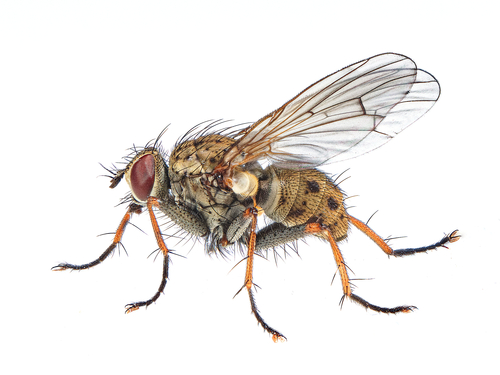
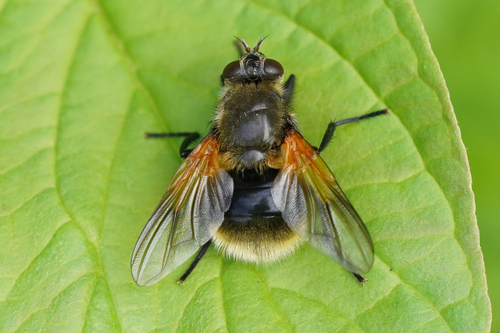
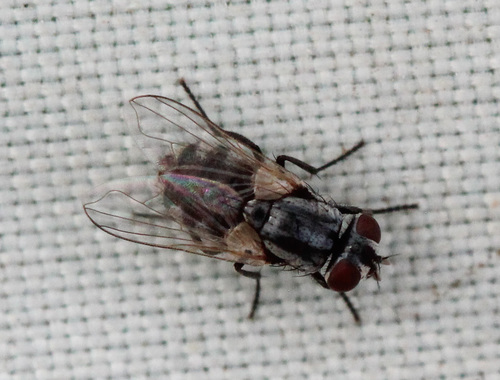
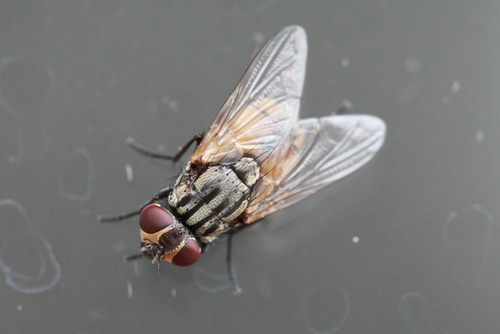
Description: Adult houseflies are usually 6 to 7 mm (1⁄4 to 9⁄32 in) long, with a wingspan of 13 to 15 mm (1⁄2 to 19⁄32 in). Females tend to have larger wings than males, while males have relatively longer legs. Female size varies more, and geographic variation exists, with larger individuals found at higher latitudes. The head is strongly convex at the front, and flat and slightly conical at the back. The pair of large compound eyes almost touch in males, but are more widely separated in females. They have three simple eyes (ocelli) and a pair of short antennae. Houseflies process visual information around seven times more quickly than humans, which lets them identify and avoid attempts to catch or swat them, because their higher flicker fusion rate lets them effectively see human movements in slow motion.
Their mouthparts are specially adapted for a liquid diet; the mandibles and maxillae are reduced and non-functional, and the other mouthparts form a retractable, flexible proboscis with an enlarged, fleshy tip called the labellum. This is a sponge-like structure marked by many grooves, called pseudotracheae, that suck up fluids via capillary action. It is also used to spread saliva to soften solid foods or collect loose particles. Houseflies have chemoreceptors, the organs that detect taste, on the tarsi of their legs, so they can identify foods like sugars by walking across them. Houseflies are often seen cleaning their legs by rubbing them together, which lets their chemoreceptors freshly taste whatever they walk on next.
At the end of each leg is a pair of claws, and below the claws are two adhesive pads called pulvilli, which let houseflies walk up smooth walls and ceilings using Van der Waals forces. The claws help the housefly unstick its foot for the next step. On horizontal and vertical surfaces, houseflies use a common walking gait where three legs contact the surface and three are in movement. On inverted surfaces, they change their gait to keep four feet stuck to the surface. Houseflies land on a ceiling by flying straight toward it; just before landing, they do a half roll and point all six legs at the surface, absorb shock with the front legs, and stick to the surface moments later with the other four.
The thorax is gray, sometimes even black, with four dark, longitudinal bands of even width on its dorsal surface. The whole body is covered with short hairs. Like other Diptera, houseflies only have one pair of wings; what would be the hind pair is reduced to small halteres that help with flight stability. The wings are translucent, with a yellowish tinge at their base. Characteristically, the medial vein (M1+2 or fourth long vein) has a sharp upward bend. Each wing has a lobe at the back, called the calypter, that covers the haltere. The abdomen is gray or yellowish, with a dark stripe and irregular dark markings on the side. It has 10 segments that bear spiracles for respiration. In males, the ninth segment has a pair of claspers for copulation, and the 10th segment bears anal cerci in both sexes.
Many species around the world look similar to the housefly, such as the lesser house fly Fannia canicularis, the stable fly Stomoxys calcitrans, and other members of the genus Musca like M. vetustissima, the Australian bush fly, plus several closely related taxa including M. primitiva, M. shanghaiensis, M. violacea, and M. varensis. Accurate systematic identification of species may require region-specific taxonomic keys, and dissection of male reproductive structures to confirm identity.
Distribution: The housefly is likely the most widely distributed insect in the world. It is largely associated with humans, and has accompanied humans across the globe. It is found in the Arctic as well as the tropics, where it is abundant. It occurs in all populated parts of Europe, Asia, Africa, Australasia, and the Americas.
Life cycle: Each female housefly can lay up to 500 eggs in her lifetime, in several batches of 75 to 150 eggs each. The eggs are white, around 1.2 mm (1⁄16 in) long, and are deposited in a suitable location, usually dead and decaying organic matter like food waste, carrion, or feces. Larvae (maggots) hatch from the eggs within one day, and live and feed where they were laid. They are pale-whitish, 3 to 9 mm (1⁄8 to 11⁄32 in) long, thinner at the mouth end, and legless. Larval development takes from two weeks under optimal conditions, to 30 days or more in cooler conditions. Larvae avoid light; the interior of animal manure heaps provide nutrient-rich, ideal growing conditions that are warm, moist, and dark.
At the end of their third instar, larvae crawl to a dry, cool place and transform into pupae. The pupal case is cylindrical with rounded ends, about 8 mm (5⁄16 in) long, and is formed from the last shed larval skin. It is yellowish at first, and darkens through red and brown to nearly black as it ages. Pupae complete their development in two to six days at 35 °C (95 °F), but may take 20 days or more at 14 °C (57 °F).
When metamorphosis is finished, the adult housefly emerges from the pupa. To do this, it uses the ptilinum, an eversible pouch on its head, to tear open the end of the pupal case. After emerging from the pupa, the adult stops growing; a small adult is not necessarily young, but instead develops from insufficient nutrition during the larval stage. Male houseflies reach sexual maturity after 16 hours, and females after 24 hours. Females produce a pheromone, (Z)-9-tricosene (muscalure). This cuticular hydrocarbon is not released into the air, and males only sense it when in contact with females; this compound has been used in pest control to lure males into fly traps.
Males initiate mating by bumping into the female, either in the air or on the ground, an action called a "strike". The male climbs onto her thorax, and if the female is receptive, a courtship period follows in which the female vibrates her wings and the male strokes her head. The male then reverses onto her abdomen, the female pushes her ovipositor into his genital opening, and copulation with sperm transfer lasts for several minutes. Females normally mate only once, then reject further advances from males, while males mate multiple times. A volatile semiochemical deposited by females on their eggs attracts other gravid females, and leads to clustered egg deposition.
Larvae depend on warmth and sufficient moisture to develop; generally, warmer temperatures lead to faster growth. In general, fresh swine and chicken manures provide the best conditions for developing larvae, reducing the larval period and increasing pupal size. Cattle, goat, and horse manures produce fewer, smaller pupae, while mature swine manure composted with a water content under 30% leads to nearly 100% larval mortality. Under different conditions, pupae can range in weight from about 8–20 milligrams (0.12–0.31 gr).
The entire life cycle can be completed in seven to ten days under optimal conditions, but may take up to two months in adverse circumstances. In temperate regions, 12 generations may occur per year, and in the tropics and subtropics, more than 20 generations occur.
Ecology: Houseflies play an important ecological role in breaking down and recycling organic matter. Adults are mainly carnivorous; their primary food sources are animal matter, carrion, and feces, but they also consume milk, sugary substances, and rotting fruit and vegetables. Solid foods are softened with saliva before being sucked up. They can act as opportunistic blood feeders.
Houseflies have a mutualistic relationship with the bacterium Klebsiella oxytoca, which can live on the surface of housefly eggs and deter fungi that compete with housefly larvae for nutrients. Adult houseflies are diurnal and rest at night. If inside a building after dark, they tend to congregate on ceilings, beams, and overhead wires, while outdoors they crawl into foliage or long grass, or rest in shrubs, trees, or on wires. In cooler climates, some houseflies hibernate during winter, choosing to hibernate in cracks and crevices, gaps in woodwork, and the folds of curtains. They emerge in spring when the weather warms, and search for a place to lay their eggs.
Houseflies have many predators, including birds, reptiles, amphibians, various insects, and spiders. Eggs, larvae, and pupae have many species of stage-specific parasites and parasitoids. Some of the most important are the parasitic wasps Muscidifurax uniraptor and Spalangia cameroni; these wasps lay their eggs in housefly larval tissue, and their offspring finish development before adult houseflies can emerge from the pupae. Hister beetles feed on housefly larvae in manure heaps, and the predatory mite Macrocheles muscae domesticae consumes housefly eggs, with each mite eating 20 eggs per day.
Houseflies sometimes carry phoretic (non-parasitic) passengers, including mites like Macrocheles muscaedomesticae and the pseudoscorpion Lamprochernes chyzeri. The pathogenic fungus Entomophthora muscae causes a fatal disease in houseflies. After infection, fungal hyphae grow throughout the body, killing the housefly in about five days. Infected houseflies have been observed seeking high temperatures that could suppress fungal growth. Affected females tend to be more attractive to males, but the interactions between the fungus and its host have not been fully studied. The housefly also acts as an alternative host for the parasitic nematode Habronema muscae that attacks horses. A virus that causes salivary gland enlargement, salivary gland hypertrophy virus (SGHV), spreads among houseflies through contact with food, and infected female houseflies become sterile.