About Musa basjoo Siebold & Zucc. ex Iinuma
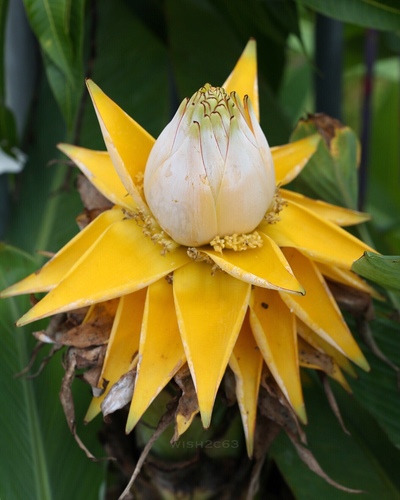
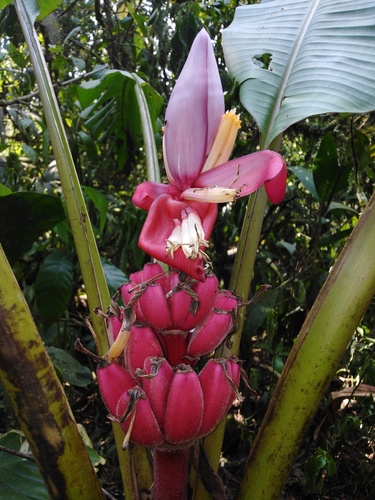
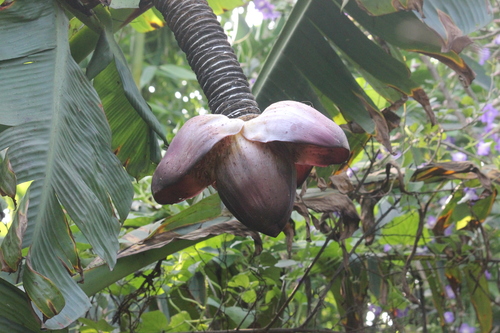
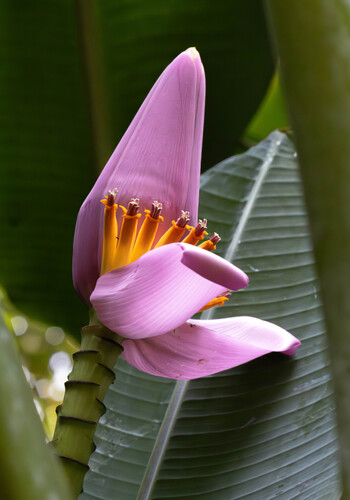
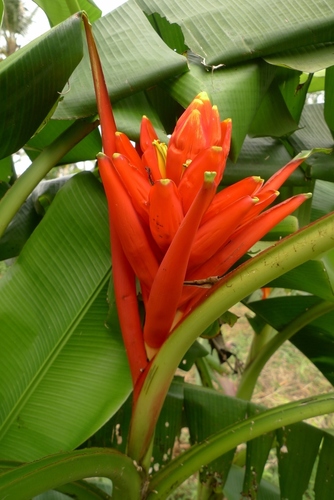
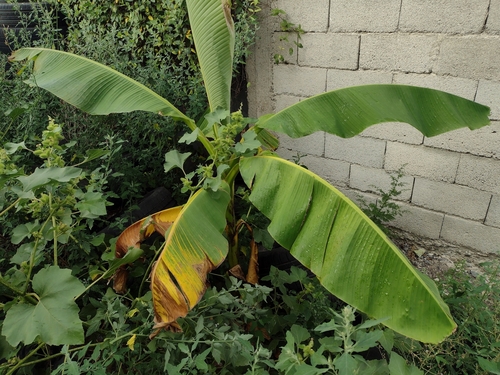
Musa basjoo is a herbaceous perennial plant. It has trunk-like pseudostems that reach around 2 to 2.5 meters (6.6 to 8.2 feet) in height, topped with a crown of mid-green mature leaves that grow up to 2 meters (6.6 feet) long and 70 centimeters (28 inches) wide. This species produces both male and female flowers on the same inflorescence, which can grow to over 1 meter (3.3 feet) in length. The resulting banana fruits are yellow-green, measuring around 5 to 10 centimeters (2.0 to 3.9 inches) long and 2 to 3 centimeters (0.79 to 1.18 inches) broad. These fruits are inedible, with sparse white pulp and numerous black seeds.
Outside its natural range, Musa basjoo has been cultivated both for its fiber and as an ornamental garden plant. Cultivation first began in Japan, and spread from the late 19th century to warmer parts of western and central Europe (north of the United Kingdom), the United States, and southern Canada. In gardens, it is grown as a hardy tropical foliage plant. While the above-ground pseudostem can only tolerate a few degrees of freezing temperature, the underground rhizome is considered frost hardy. When well insulated with thick mulch, it can survive winter temperatures as low as −12 °C (10 °F), and potentially even lower with proper mulching. The roots are hardy to −10 °C (14 °F). If the pseudostem is killed by cold, the plant will resprout from the ground, growing rapidly to full size in a single season under optimal conditions. This allows it to be grown as far north as USDA zone 6a. It can also be overwintered indoors in a pot to keep growing, which is the only way to get it to fruit in northern regions, as it requires 12 to 24 months of warmth to bloom. In the United Kingdom, Musa basjoo has received the Royal Horticultural Society's Award of Garden Merit.
In traditional Chinese medicine, the stem, flower, leaves, and rhizome of Musa basjoo are considered useful for clearing heat-toxins, quenching thirst, and promoting urination.