About Musa acuminata Colla
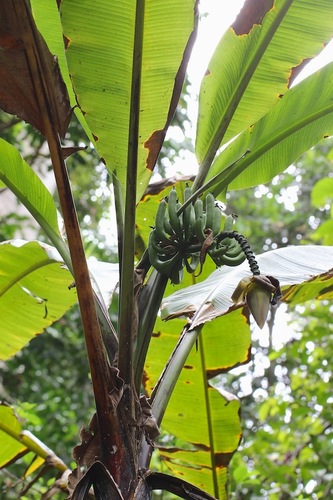
Botanists classify Musa acuminata Colla as an evergreen, perennial herbaceous plant, not a tree. Its trunk-like structure, called a pseudostem, is formed from tightly packed layers of leaf sheaths that grow from completely or partially buried corms. Leaves grow at the top of the leaf sheaths or petioles; in the subspecies M. a. truncata, the leaf blade can reach up to 6.7 m (22 feet) long and 0.99 m (39 inches) wide.
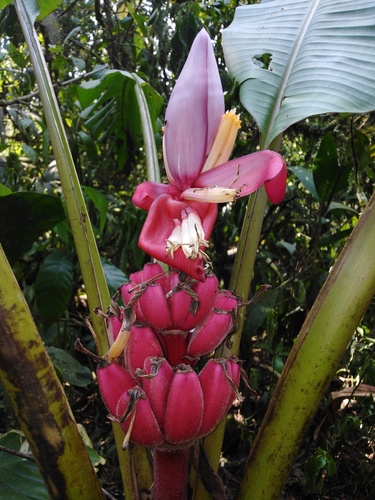
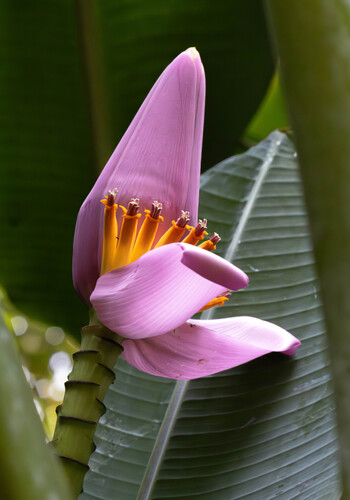
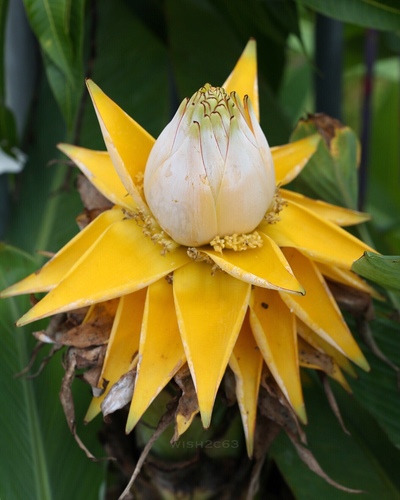
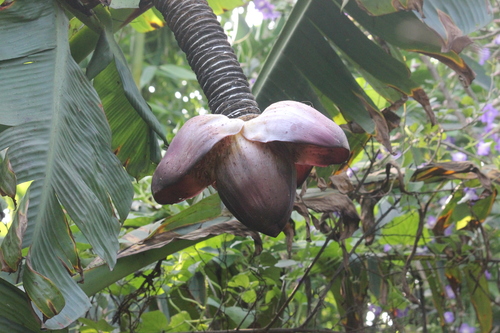
The inflorescence grows horizontally or obliquely out from the pseudostem. Individual flowers are white to yellowish-white, and are negatively geotropic, meaning they grow upwards away from the ground. A single inflorescence contains both male and female flowers. Female flowers sit near the base of the inflorescence and develop into fruit, while male flowers are located at the pointed tip bud, between leathery bracts.
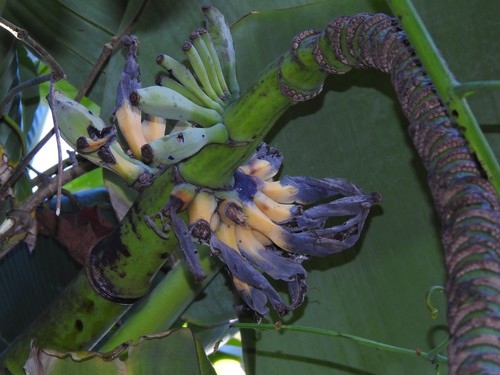
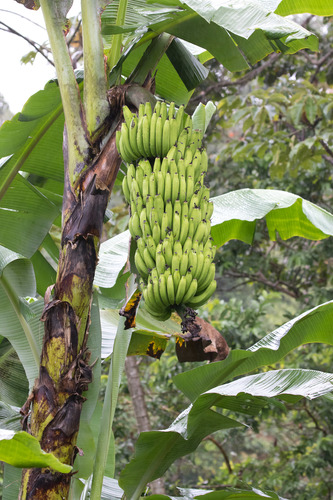
The fruits, which are relatively slender berries, have sizes that vary based on the number of seeds they contain. Each fruit can hold 15 to 62 seeds. A single fruit bunch averages 161.76 ± 60.62 individual fruits, and each fruit measures approximately 2.4 by 9 cm (1 by 3+1⁄2 inches). Seeds of wild M. acuminata are around 5 to 6 mm (3⁄16 to 1⁄4 inch) in diameter. They are subglobose or angular in shape, and are very hard. A tiny embryo sits at the end of the micropyle. Typically, each M. acuminata seed is surrounded by around four times the seed's volume of edible starchy parenchyma pulp, the portion of bananas that is eaten, which equals approximately 0.23 cm3 (230 mm3; 0.014 cu in).
Wild M. acuminata is diploid, with 2n=2x=22 chromosomes. Most cultivated varieties (cultivars) are triploid (2n=3x=33) and parthenocarpic, meaning they produce fruit without viable seeds. The most well-known dessert banana cultivars belong to the Cavendish subgroup. These high-yielding cultivars were developed by selecting natural mutations that occur during the normal vegetative propagation used in banana farming. In "seedless" edible cultivars, the ratio of edible pulp to seeds increases dramatically: small, largely sterile seeds are surrounded by 23 times the seed's size in edible pulp, and the seeds are reduced to tiny black specks along the fruit's central axis.
Musa acuminata is native to the Malesia biogeographical region and most of mainland Indochina. The species prefers wet tropical climates, which distinguishes it from the hardier M. balbisiana, a species that M. acuminata has hybridized with extensively to produce almost all modern edible banana cultivars. Any spread of the species outside its native range is thought to be caused entirely by human activity. Early farmers introduced M. acuminata into the native range of M. balbisiana, leading to hybridization and the development of modern edible clones. Around 4000 years ago (2000 BCE), AAB cultivars spread from a location near the Philippines, leading to the distinct banana cultivars of the Maia Maoli or Popoulo group found in Pacific islands. It has been suggested these cultivars may have been introduced to South America during Precolumbian times by early Polynesian sailors, but evidence for this introduction is debatable.
Westward spread of the species reached Africa, where there is evidence of M. acuminata × M. balbisiana hybrid cultivation dating as far back as 1000 to 400 BCE. Hybrids were probably first introduced to Madagascar from Indonesia. From West Africa, the Portuguese introduced these hybrids to the Canary Islands in the 16th century, and from the Canary Islands they were introduced to Hispaniola, which today is Haiti and the Dominican Republic, in 1516.
Wild Musa acuminata reproduces either sexually via seeds or asexually via suckers. Edible parthenocarpic cultivars are usually grown from suckers in plantations, or cloned via tissue culture. Seeds are still used in research to develop new cultivars.
M. acuminata is a pioneer species that rapidly colonizes newly disturbed areas such as sites recently affected by forest fires. It is considered a keystone species in certain ecosystems, enabling greater wildlife diversity to develop after it becomes established in an area. It is particularly important as a food source for wildlife due to its rapid regeneration. The structure of M. acuminata flowers makes self-pollination difficult. It takes approximately four months for flowers to develop into fruit, and fruit clusters near the base of the inflorescence ripen earlier than clusters at the tip.
A wide range of wildlife feeds on M. acuminata fruits, including frugivorous bats, birds, squirrels, tree shrews, civets, rats, mice, monkeys, and apes. These animals also act as important seed dispersers for the species. Mature seeds germinate easily 2 to 3 weeks after sowing. When stored unsprouted, seeds can remain viable for between a few months and two years. Even so, studies have found that clone plantlets are far more likely to survive than seedlings grown from seeds.