About Mus spicilegus Petényi, 1882
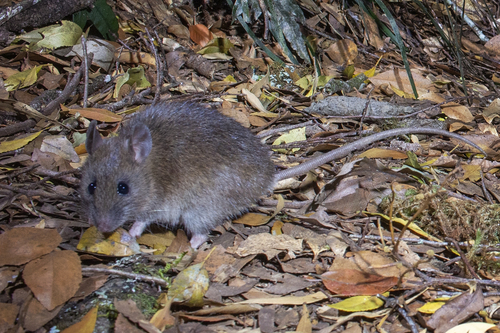
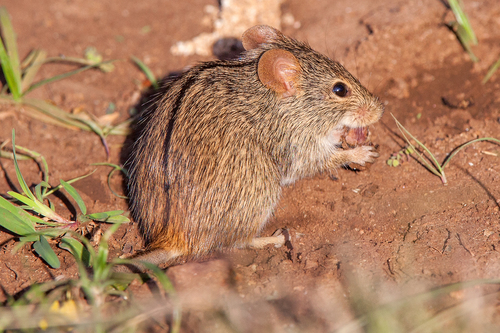
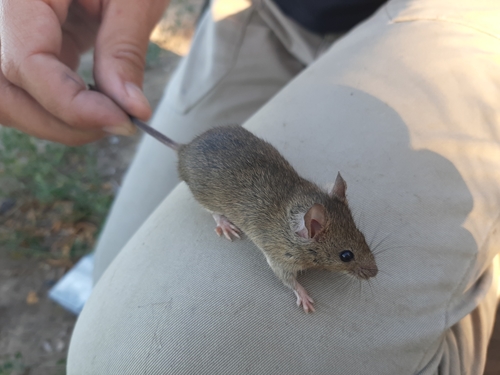
Mus spicilegus has a head-and-body length of 70 to 80 mm (2.76 to 3.15 in), and a tail length of 55 to 65 mm (2.17 to 2.56 in). Its fur is mostly a solid uniform grey with no red tint, though some populations are bicoloured with paler underparts. Its tail is more slender than the tails of other closely related species. It looks very similar to the common house mouse (Mus musculus), and the two species are often confused. The most notable difference between them is M. spicilegus's tendency to build mounds, a trait that is only visible at certain times of year. This species inhabits grassland, steppe, cultivated land, orchards, clearings, and woodland borders. It is unique among mice for its habit of building mounds in the autumn. Multiple mice work together to build these structures, which can reach up to 4 m (13 ft) in diameter; the more typical size range is 1 to 2 m (3 to 7 ft) across. Between four and fourteen mice cooperate to build each mound, and these cooperating groups are made up of closely related individuals, usually connected through the maternal line. Mounds are built above storage chambers that can hold up to 10 kg (22 lb) of seeds and grains, with a nesting chamber located beneath the storage area. A typical density is up to twenty mounds per hectare (eight per acre), but much higher densities can occur in especially favourable conditions. Breeding in this species is seasonal, occurring from around March to October. Young females that are six to eight months old and have overwintered in a mound breed in spring, and may produce four or five litters in a single year; in central Ukraine, the average litter size is 6.7 young. During the summer, most individuals live in simple burrows, though some remain in the mound. If a mound stays intact through the summer, it may be reused for autumn and winter shelter. New mounds are built between mid-August and mid-November, when cereal crops ripen and other plants produce seeds. Mound construction is carried out by juveniles three to four weeks old, and the finished mound serves as their winter home, with adults occasionally sharing the space. Mound construction takes two to three weeks, and the final size of the mound depends on both the number of mice working on it and how abundant available food is. Stored seed from 84 different plant species has been found in these mounds.