About Murraya koenigii (L.) Spreng.
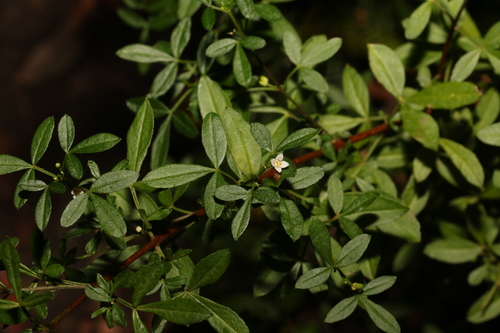
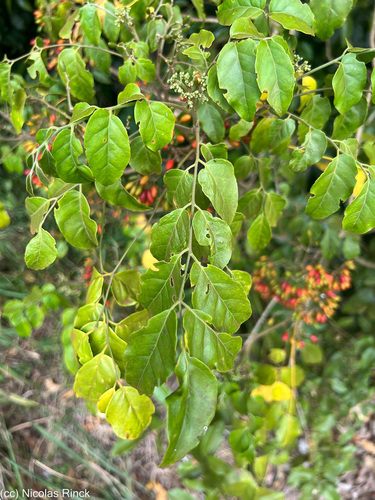
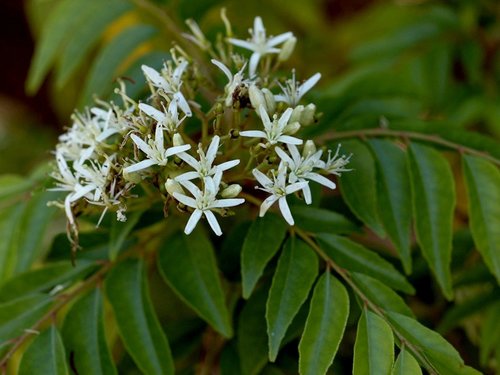
Murraya koenigii (L.) Spreng. is a small tree that reaches 4–6 metres (13–20 ft) in height, with a trunk that can grow up to 40 cm (16 in) in diameter. Its leaves are aromatic and pinnate, bearing 11–21 leaflets. Each individual leaflet is 2–4 cm (3⁄4–1+1⁄2 in) long and 1–2 cm (1⁄2–3⁄4 in) broad. This plant produces small white flowers that are capable of self-pollination. After pollination, it forms small shiny-black drupes that hold a single large viable seed. The pulp of these berries is edible and has a sweet flavor. This tree is native to multiple regions: on the Indian subcontinent it grows in Assam, Bangladesh, East Himalaya, India, Nepal, Pakistan, Sri Lanka, and West Himalaya; in China it is native to South-Central China, Southeast China, and Hainan; and in Indo-China it is native to Cambodia, Laos, Thailand, and Vietnam. It has been introduced to the Andaman Islands, Christmas Island, Fiji, Java, the Laccadive Islands, the Maldives, the Nicobar Islands, and Sumatra. It has also been introduced to Queensland, Australia, where it is classified as an environmental weed. Commercial plantations of Murraya koenigii have been established in India, Australia, and Costa del Sol, Spain. For cultivation, Murraya koenigii grows best in well-drained soil that does not dry out, in locations with full sun or partial shade, and preferably in positions sheltered from wind. Its growth is more robust when temperatures stay at or above 18 °C (64 °F).