About Muraena helena Linnaeus, 1758
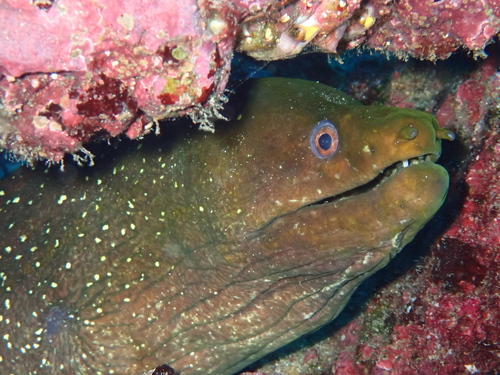
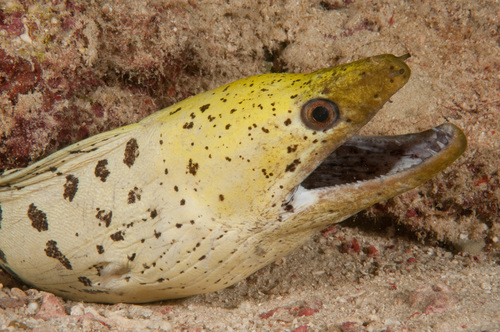
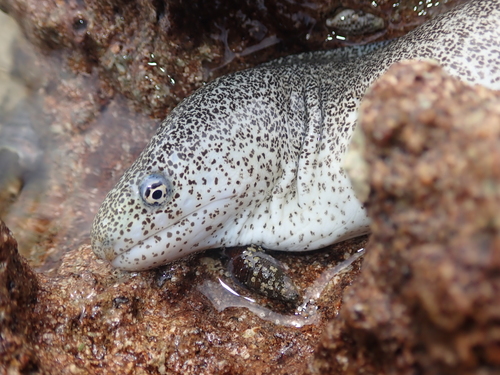
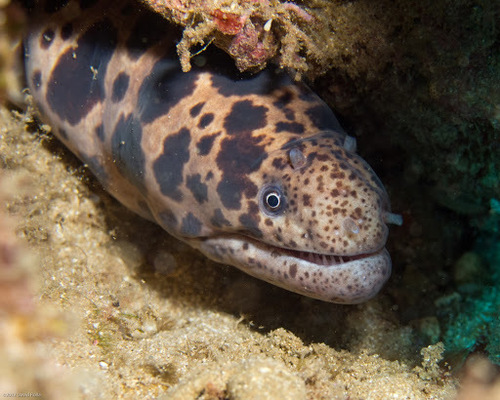
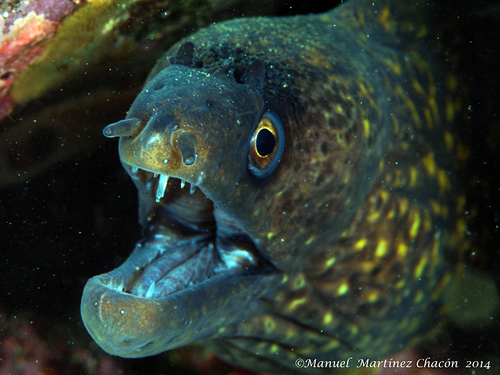
This species is scientifically named Muraena helena Linnaeus, 1758, commonly known as the Mediterranean moray. It has an elongated, eel-like body, and can grow up to 1.5 metres (4 ft 11 in) long and weigh over 15 kilograms. Its coloration ranges from dark grey to dark brown, marked with fine dark spots. Its skin is slimy and lacks scales. The dorsal fin starts behind the head and runs continuously to the caudal fin, which is fused with the anal fin. This species has no pectoral fins; its teeth are long and sharp-pointed, similar to those of other morays, and its mouth is long and robust, extending behind the gills. The Mediterranean moray inhabits coastal eastern Atlantic Ocean waters from the British Isles to the coast of Senegal, as well as the waters around the Canary Islands, the Azores, and the entire Mediterranean Sea. It prefers rocky bottoms, and lives at depths between 1 and 801 metres, with the 100–300 m depth range being its most common habitat. It is a solitary, territorial species. It spends most of the day hiding in cavities and clefts between rocks, and is more active during the night. It hunts fish, crabs, and cephalopods, and will also feed on dead animals. Sex and maturity of this species are determined by visual observation of the gonads: mature females have large orange eggs, while mature males have large white testes. Mediterranean morays found in the Adriatic Sea mature during warmer months, spawn in summer, and enter a resting period during colder months. This species releases around 60,000 eggs into open water, and planktonic transparent leptocephali hatch from these eggs. The act of reproduction in eels is still poorly understood, as it has never been observed in the wild, and the Mediterranean moray is no exception. It is confirmed that eels reproduce via external fertilization.