About Muntiacus reevesi (Ogilby, 1839)
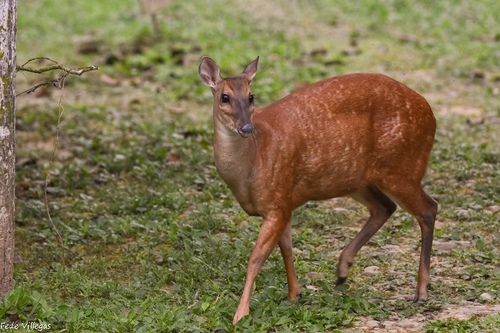
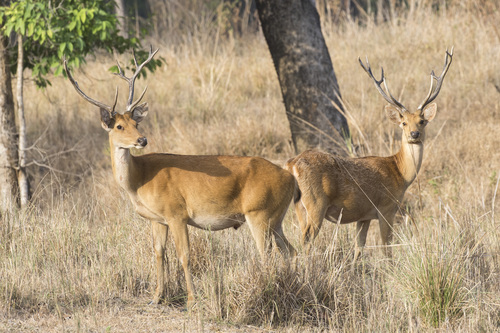
Reeves's muntjac, scientific name Muntiacus reevesi (Ogilby, 1839), reaches 0.5 m (1 ft 8 in) in shoulder height and 0.95 m (3 ft 1 in) in body length, with an additional short tail that grows up to 4 in (10 cm) long. Fully grown adults weigh between 10 and 18 kg (22 and 40 lb). This species has a reddish-brown overall coat, with striped markings on the face. Its belly is creamy-white, and lighter-colored fur extends to the neck, chin, and the underside of the tail. Males have short antlers, usually 4 in (10 cm) or less in length, and long upper canine tusks that are typically around 2 in (5.1 cm) long. Females have bony lumps on their foreheads and localized black spots. The Taiwanese subspecies M. r. micrurus, commonly called the Formosan Reeves's muntjac, has darker coloration than other subspecies. This species is widely distributed across southeastern China, ranging from Gansu to Yunnan, and Taiwan. It has also been introduced to several other regions. Female Reeves's muntjacs, called does, reach sexual maturity within their first year of life. Mating can take place throughout the entire year. Gestation lasts from 209 to 220 days. Females limit the total number of mating bouts, while the interval between successive mating bouts is determined by males, called bucks.