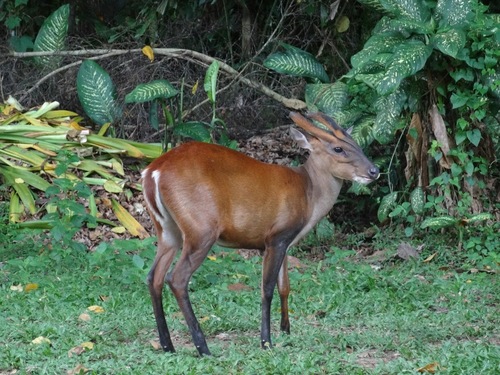
About Muntiacus muntjak vaginalis (Boddaert, 1785)
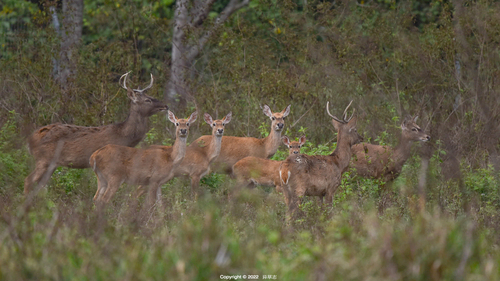
Characteristics: The southern red muntjac has a short, very soft, thick, dense coat, which becomes denser in cooler regions. Its face is darker, and its limbs range from dark to reddish brown. Coat color changes seasonally from darker brown to yellowish or grayish brown, and the underbelly is white. Its ears have far less hair than other parts of the head, but match the head’s color. Male muntjacs have short antlers, around 10 cm (3.9 in) long, that grow from long, hair-covered pedicels above the eyes. Females have fur tufts and small bony knobs in place of antlers. Males also have elongated, slightly curved upper canines that are 2–4 cm (0.79–1.57 in) long; these canines are used in conflicts between males and can inflict serious injury. Body length ranges from 89 to 135 cm (35 to 53 in), tail length ranges from 13 to 23 cm (5.1 to 9.1 in), and shoulder height ranges from 40 to 65 cm (16 to 26 in). Adult weights fall between 13 and 35 kg (29 and 77 lb), and males are larger than females. Unique among deer, muntjacs have large, visible preorbital scent glands on their face in front of the eyes, which they use to mark territories or attract females. Males have larger glands than females. Distribution and habitat: The southern red muntjac, previously called the common muntjac, is found in the Malay Peninsula, Sumatra, Java, Bali, and Borneo. It is also assumed to occur in peninsular Thailand and southwestern Myanmar, and it is locally extinct in Singapore. This species is mostly associated with low-density forest habitats, but it can also live in heavily degraded forest, and in forest areas adjacent to coffee, cassava, rubber, sugarcane, coconut, and teak plantations. It adapts well to logging-altered areas, and appears to benefit from agricultural conversion of forest edges. In young acacia plantations under 4 years old in Bintulu Division, Sarawak, East Malaysia, southern red muntjacs (along with other muntjac species) are among the most frequently camera-trapped species. Footprints are common in newly planted areas and nearby remaining forest patches, and muntjacs have been observed browsing on young acacia shoots. In Danum Valley, Borneo, an area with very little hunting, population density of this species has been observed to increase after deforestation. Ecology and behavior: The southern red muntjac is also called barking deer for the bark-like alarm sound it produces when danger is present. Outside of the mating season (rut) and the first six months after a female gives birth, adult muntjacs are solitary. Adult males in particular maintain spaced-out ranges, and marking grass and bushes with secretions from their preorbital glands appears to play a role in gaining and holding territory. Males gain territories and mark them with scent by rubbing their preorbital glands (located on the face just below the eyes) on the ground and trees, scraping their hooves against the ground, and scraping tree bark with their lower incisors. These scent markers let other muntjacs know if a territory is already occupied. Males often fight with each other over territories, sufficient vegetation, and access to females during mating, using their short antlers and the more dangerous canines as weapons. Males that cannot gain their own territory are very likely to be killed by predators. During the rut, males temporarily ignore territorial boundaries, allowing territories to overlap, and roam continuously searching for receptive females. Predators of adult southern red muntjacs include tigers, leopards, clouded leopards, pythons, crocodiles, dholes, Asiatic black bears, fishing cats, Asian golden cats, and golden jackals. Foxes, raptors, and wild boars hunt fawns. Southern red muntjacs are highly alert. When stressed or when they detect a predator, they start making their characteristic bark-like sound. Barking was originally thought to function both as communication between deer during mating season and as an alarm signal. Reproduction: Southern red muntjacs are suspected to be polygamous. Females reach sexual maturity between their first and second year of life. They are polyestrous, with each cycle lasting about 14 to 21 days and estrus lasting 2 days. Gestation lasts 6 to 7 months, and females usually give birth to one offspring at a time, though they occasionally produce twins. Females typically give birth in dense vegetation to hide from other animals and predators. Young leave their mother after around 6 months to establish their own territory. Males often fight each other to control a harem of females. Unlike other even-toed ungulates, this species shows no evidence of a fixed specific breeding season. Adults have relatively large home range overlap between both different sexes and the same sex, meaning strict territorialism does not occur, but some form of site-specific dominance does exist.