About Munida rugosa (Fabricius, 1775)
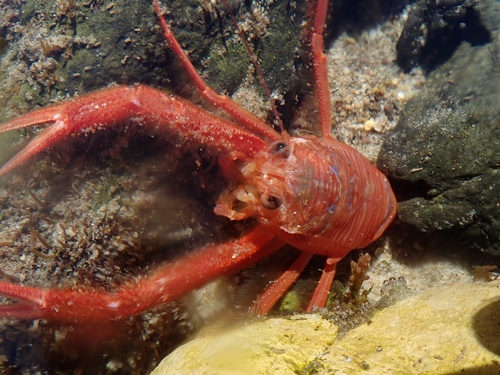
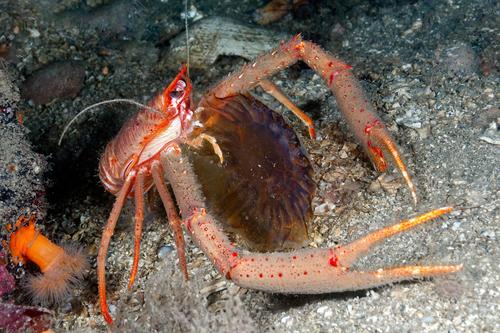
Munida rugosa has an orange body with darker transverse bands across its carapace and abdomen. It reaches a maximum total length of 10 centimetres (3.9 in); like other species in its genus, it folds its abdomen beneath its cephalothorax. The carapace, including the rostrum, measures about 30 millimetres (1.2 in) long. The carapace bears a small number of spines along its back edge, and the rostrum has one central spine, with two shorter spines flanking it above the eyes. Its thread-like antennae are slightly shorter than the first pair of appendages, which end in long, narrow white pincers. The following three pairs of limbs, which are used for walking, also have white tips. The fifth pair of limbs is especially thin and is usually held beneath the margins of the carapace. This species has relatively small eyes, and its physical morphology varies across its geographic range. Specimens from more southerly parts of the range are more spiny, have more setae on the abdomen, and have longer, more slender limbs. Munida rugosa occurs in the western Mediterranean Sea, around Madeira, in the northeastern Atlantic Ocean, in the North Sea, and in adjacent continental waters north of 25°N. It lives at depths down to 150 metres (490 ft), and is typically found in cracks or under boulders.