About Multiclavula mucida (Pers.) R.H.Petersen
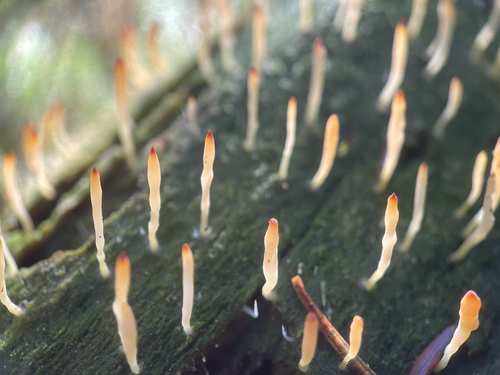
Multiclavula mucida (Pers.) R.H.Petersen has a Botrydina-type thallus, a structure common in basidiolichens. In this thallus, algae are not scattered; instead, they are organized into small, closely packed globules embedded in a gelatinous matrix that grows on moist, rotting wood. This structure protects algae from UV light and desiccation, while a hyphal network maintains close contact between partners and supplies a continuous flow of water and minerals to the algae. Where the fungus produces fruiting bodies, the algae form a green granular crust: algal partners are encapsulated in tiny pockets of fungal tissue, but still retain a loose, unstructured form. Even though the two partners have a mutualistic relationship, both the alga and the fungus maintain their individual distinct morphologies. The first documentation of the relationship between coccomyxoid green algae and Multiclavula mucida was published by Geitler in 1955, who noted that algae grow larger when inside the lichen than they do when living freely. In 1956, Geitler suggested this size difference occurs because the fungal partner, the mycobiont, reduces the frequency of algal cell division. Later, electron microscopy work by Hiroshi Masumoto confirmed the specific photobiont partner of M. mucida is Elliptochloris subsphaerica. The fruiting bodies, called basidiocarps, are usually simple to lobed and can grow up to 2 cm (0.8 in) tall. They have a waxy-tough texture, but can become slimy, and change color as they mature, shifting from white or creamy to grey or pale tan. Dried fruiting bodies often show a pure white tip. The sticky surface of these structures frequently causes debris to adhere to them. Internally, the fungus has hyphae with thin to slightly thick walls. These hyphal threads are generally arranged parallel to each other, are interlocking, often fused, and have frequent branching and connecting points called anastomoses. Hyphae also have clamp connections—small bridge-like structures that connect adjacent cells—and can reach up to 200 μm in length. Below the outer surface layer, thinner, more twisted hyphae produce basidia as side branches. Basidia are typically short and narrow, with four to six outgrowths called sterigmata that release spores. They measure 15–25 by 4–6 μm. Spores are ovoid to ellipsoid, smooth, guttulate (meaning they contain one or two oil droplets), produce white spore prints, and measure 4.5–7.7 by 1.8–3.2 μm. M. mucida shows no reaction to any standard chemical spot tests, and is not known to produce any secondary metabolites, also called lichen products. David Arora describes the edibility of this species' small, short-lived fruit bodies as "utterly inconsequential". This species is most commonly found growing on decomposing wood, often in the presence of algae. It grows well on a wide range of woody substrates, including bamboo, beech, cedar, poplar, and oak; in Central Europe, it particularly favours coniferous wood. Unlike other species in its genus, which prefer sandy soils, M. mucida grows almost exclusively on rotting wood in moist environments. Lothar Geitler first identified this species as an extratropical lichen in 1955, which challenged the widely accepted belief at the time that all basidiolichens were restricted to tropical regions. Historically, M. mucida was considered native only to Northern Europe and the mountains of Central Europe, but it has since been increasingly observed across most European countries and around the world. This apparent expansion of its known range may be due to the creation and maintenance of natural forest reserves, which create the ideal habitat for the species by supporting the decay of large thick logs. The species is widely distributed globally, with confirmed populations in Asia, Europe, North America, and South America, and possible populations in Australia. Its North American range extends as far north as Alaska, and it has also been documented in Australia (including Tasmania) and New Zealand. The discovery of M. mucida at unusually low elevations (around 130 to 135 m, or 427 to 443 ft, above sea level) in the Bienwald area of Rhineland-Palatinate has led scientists to reevaluate its distribution and resolve inconsistent naming of the species across different scientific publications. Historically, the species has experienced population declines caused by intensive forestry and environmental pollution, particularly soil acidification from sulfur dioxide emissions, which damage its natural habitats.