About Mullus barbatus Linnaeus, 1758
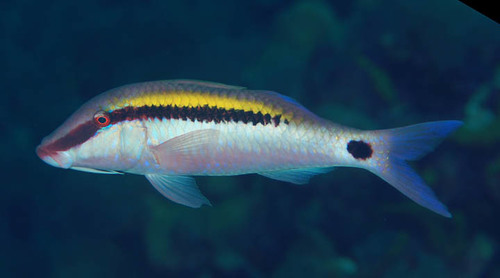
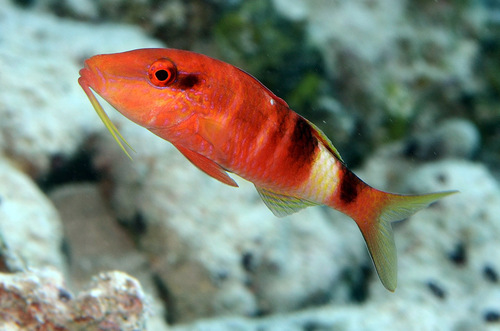
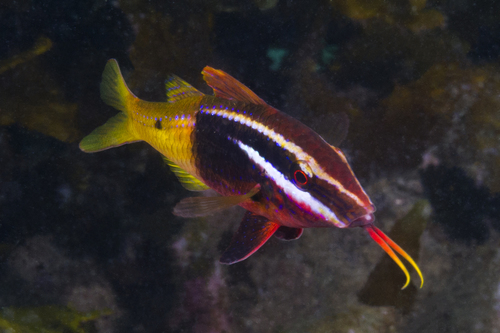
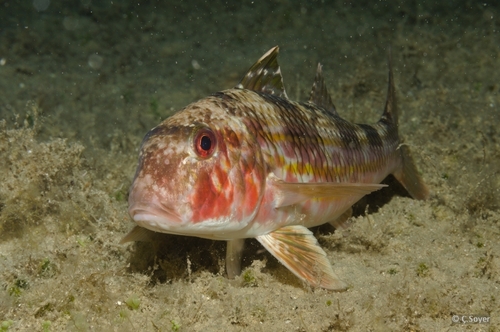
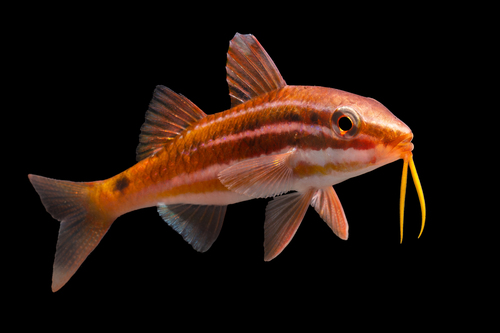
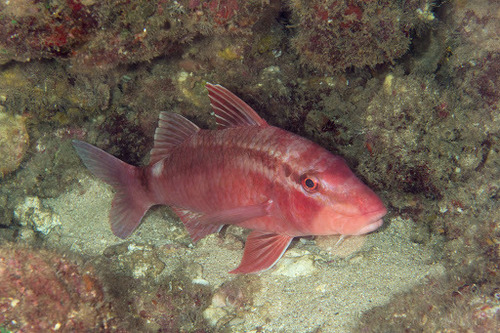
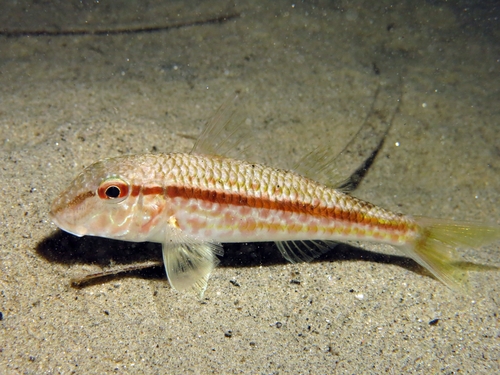
This species, the red mullet (scientific name Mullus barbatus Linnaeus, 1758), can reach a standard length of 30 cm (12 in), though most individuals grow to about half this maximum size. Its body is somewhat compressed along the lateral sides. It has a short, steep snout, and no spines on the operculum. The upper jaw has no teeth, but teeth are present on the lower jaw and the roof of the mouth. A pair of moderately long barbels grows from the chin, and these do not grow longer than the pectoral fins. The first dorsal fin has eight spines, the first of which is very small; the second dorsal fin has one spine and eight soft rays. The fish's body is rose-pink, with no distinctive markings on its fins. Red mullet are distributed in the Mediterranean Sea, the Black Sea, and the northeastern and central eastern Atlantic Ocean. In the Atlantic, their range extends south from Scandinavia to Senegal, and includes the Canary Islands, Azores, and Madeira. They are demersal fish, found at depths between 10 and 328 m (30 to 1,080 ft) over muddy, sandy, or gravel bottoms. Red mullet are carnivorous, feeding mainly on polychaete worms, bivalve molluscs, and crustaceans. Their chin barbels are sensory organs that help them locate prey. Both young and adult red mullet are preyed on by a range of other fish, including the angler fish (Lophius piscatorius), the thornback ray (Raja clavata), the common stingray (Dasyatis pastinaca), the school shark (Galeorhinus galeus), the John Dory (Zeus faber), and the European hake (Merluccius merluccius). Breeding occurs in spring and summer; in the Adriatic Sea, spawning takes place in April and May at depths between 60 and 70 m (200 and 230 ft). Red mullet larvae move to shallower water shortly after hatching and are pelagic, and young juveniles are also pelagic at first. When juveniles reach about 5 cm (2 in) in length, they move to coastal areas and adopt a demersal lifestyle, often congregating in estuaries and sometimes swimming a short distance upstream. Later, they disperse to muddy, sandy, or gravelly substrates, and reach sexual maturity at 10 to 14 cm (4 to 6 in) in length during their first year of life.