About Mulleripicus pulverulentus (Temminck, 1826)
Following the probable extinctions of the imperial woodpecker and the ivory-billed woodpecker, Mulleripicus pulverulentus (the great slaty woodpecker) is the largest woodpecker alive in the world today. This species measures 48–58 cm (19–23 in) in length and weighs 360–563 g (0.794–1.241 lb), with one study reporting an average weight of 430 g (15 oz). Standard measurements for the species are: wing chord 21.5 to 25 cm (8.5 to 9.8 in), tail 13.4 to 16.2 cm (5.3 to 6.4 in), bill 6 to 6.5 cm (2.4 to 2.6 in), and tarsus 3.6 to 4.1 cm (1.4 to 1.6 in).
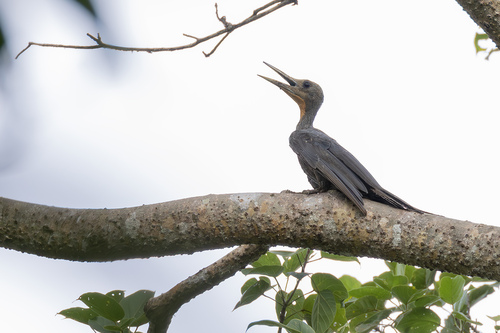
This distinctive woodpecker has several clear identifying features: a very long, strong chisel-tipped bill, an elongated neck, and a long tail. A slight crest may occasionally be visible. Its plumage is almost entirely dark grey or blackish slate-grey covered with small white spots; the throat is paler grey, and males have a small red moustache. The nominate subspecies is generally the darkest, most slaty grey race. M. p. harterti has a paler throat with more whitish feather tips that form small spots, is slightly paler on the underparts than the nominate, and sometimes appears almost whitish on the belly. Its size and body structure easily distinguish it from almost any other species, including other woodpeckers. It may occasionally be mistaken for a hornbill at first glance, but this resemblance is very slight.
Despite its large size, the great slaty woodpecker has a weak, quiet voice, especially when compared to other large woodpeckers, which typically have loud, booming voices. Its species call is a whinnying cackle made of 2 to 5 (usually 4) notes: woikwoikwoikwoik. The starting note is higher in pitch, and the middle note is distinctly lower. Single dwot calls, which vary in sound, strength, and duration, are sometimes given when the bird is perched or in flight. Breeding pairs have been recorded making soft mewing calls to each other. In antagonistic encounters, the birds give sharp taw-whit or dew-it calls while swinging their heads back and forth.
This species is found across the Indian subcontinent and Southeast Asia, occurring in Bangladesh, Bhutan, Brunei, Cambodia, India, Indonesia, Laos, Malaysia, Myanmar, Nepal, the Philippines, Singapore, Thailand, and Vietnam. It lives in the Greater Sundas, but does not inhabit Bali.
The great slaty woodpecker prefers to live in primary semi-open, moist deciduous, and tropical evergreen forest. It can occasionally move into adjacent secondary forests, clearings with scattered tall trees, and similar open park-like areas, but it generally does not enter heavily disturbed areas. Locally, it prefers large, continuous stands of dipterocarp and teak trees. It can also be found in mature sal forests, swamp forest, and mangroves with tall, mature trees. It usually occurs below 600 m (2,000 ft) in elevation, but is found locally in montane areas up to 1,100 m (3,600 ft), and occasionally ranges as high as 2,000 m (6,600 ft).
Great slaty woodpeckers are most often seen in groups of 3 to 6 individuals, made up of a breeding pair and their young from previous years. Groups often forage together at shared feeding sites that are nests of social insects including ants, termites, wood-boring beetles, and stingless bees. Ants appear to be the generally favored food, though larvae of other insects are also eaten quite regularly. Occasionally, the diet is supplemented with small fruit. Females spend more time searching for feeding sources, while males (which have slightly larger bills) spend more time opening these sources. Preferred feeding sources are mostly found on large branches or trunks of large, living trees. Groups will travel quite far to reach these trees, so the species’ home ranges are quite large. Occasionally, they will feed at lower levels in trees and even among saplings. Feeding groups usually do not stay in any single area for long.
This species sometimes associates with the slightly smaller white-bellied woodpeckers and the considerably smaller greater flamebacks. The very different foraging methods of these woodpeckers minimize competition between the species. Generally, more considerable competition for food sources comes from hornbills and arboreal (tree-dwelling) mammals. The great slaty woodpecker usually works its way upward along a tree while foraging. Though it is capable of moving faster, it has been described as moving in “slow motion” while feeding. It forages by gleaning, probing, pecking, prying off bark, and hammering with powerful, loud blows to excavate wood. Gleaning is the most important foraging method for this species; its long neck and bill allow it to reach a considerable distance into cracks and crevices of trees. This species often flies high above the trees for long distances between successful foraging patches. Its feathers rustle noisily during flight. It performs less dipping in flight than other woodpeckers, and has a mixed, crow-like flying style.
Like all woodpeckers, breeding pairs roost in separate tree holes but call regularly to stay in contact. The pair bond appears to be lifelong. These woodpeckers perform displays, mostly for territorial purposes. Displays include head-swinging (in which the head lags behind the body during swinging movements), whinnying calls, and spreading their wings and tail wide. Few of this species’ nests have been described in detail, but nests are at least occasionally raised cooperatively by groups. All known nests are located in very large trees, at heights between 9 and 45 m (30 to 148 ft). Both parents take part in excavating the nest hole, but the male is reported to do the majority of the work. The nest hole entrance is around 10 cm (3.9 in) across, and is much wider inside the tree. The pair will only reuse a nest from a previous year if competition for space to build a new hole is too high. In Malaysia, the nesting season runs from March to August. The clutch reportedly contains two to four eggs, which are incubated by both parents. Both parents also feed and brood the young. Young great slaty woodpeckers probably stay with their parents until the next breeding season.