About Mulleripicus fulvus (Quoy & Gaimard, 1832)
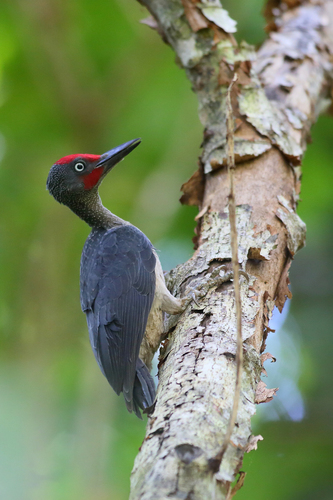
The ashy woodpecker, with the scientific name Mulleripicus fulvus, is a species of bird in the woodpecker family Picidae. It is endemic to Sulawesi and the surrounding islands of Indonesia. This species has two recognized subspecies. The nominate subspecies, M. f. fulvus, occurs in northern Sulawesi, the islands of Lembeh and Manterawu, and the Togian and Banggai archipelagos. The second subspecies, M. f. wallacei, is found in southern Sulawesi and the islands of Muna and Buton, and is named after collector and scientist Alfred Russel Wallace. Its natural habitats are tropical moist lowland forests and tropical moist montane forests. While it prefers closed forest, it can also be found in secondary forest and patches of forest within savannah. It is assumed to be non-migratory, and occurs from sea level up to 2,000 m (6,600 ft) elevation. The species is not uncommon and is currently considered secure. The ashy woodpecker is a large woodpecker, reaching 40 cm (16 in) in total length. Males have red colouration from the face to the mid-crown, with grey on the back of the head and neck. The throat, front of the neck, and belly are buff-coloured, and the remaining parts of the back and wings are grey-brown to dark slate grey. It has a long black bill, a yellow iris, and a grey eye-ring surrounding the eye. Females resemble males, but their entire head is grey, with faint spotting except on the forehead. M. f. wallacei is similar to the nominate subspecies, but the red facial colouration covers most of the head. It also has a slightly longer tail and wings, and a slightly shorter bill. Its calls include muffled laughing phrases of hew-hew-hew-hew-hew and tuk tuk tuk, which are not loud. It also drums during the breeding season. Ashy woodpeckers feed predominantly on trees, but may also break into ground termite nests. They are most often seen foraging on tree trunks. Their diet consists of termites, caterpillars, and other insects and arthropods. Little is known about their nesting behaviour. One breeding pair was observed digging a nest hole, with the male completing most of the excavation work. Nest holes are made in dead trees, or in dead sections of living trees. Clutches contain two to three eggs.