About Muhlenbergia capillaris (Lam.) Trin.
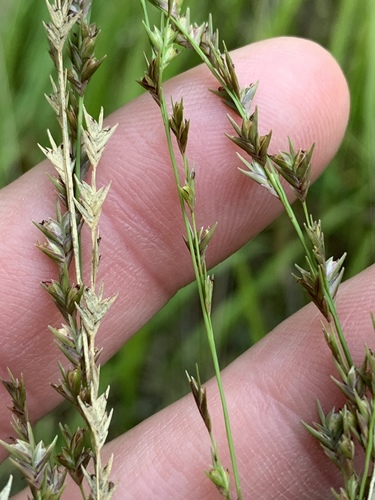
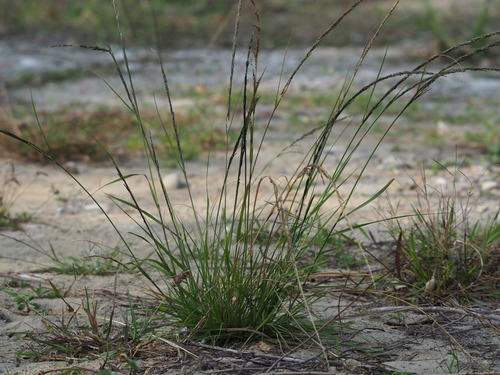
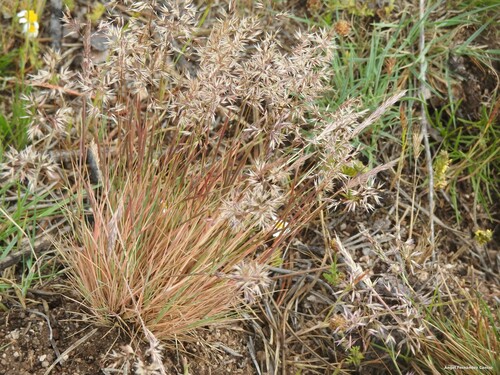
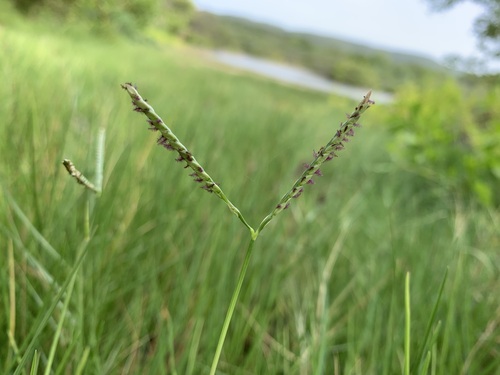
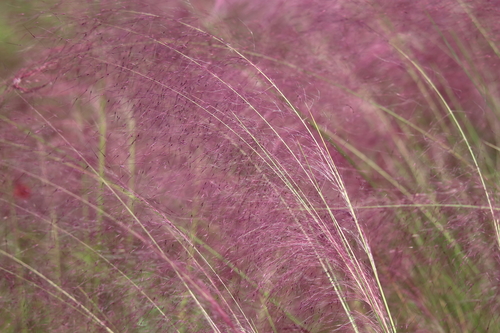
Muhlenbergia capillaris (Lam.) Trin., commonly called hairawn muhly or pink muhly grass, is a cespitose (clump-forming) warm-season perennial grass. It grows in clumps 30 to 90 cm (0.98 to 2.95 ft) tall and 60 to 90 cm (2.0 to 3.0 ft) wide, and does not spread via above-ground or underground stems. Its overall growth form has a capillary-like branching pattern, with green foliage forming an understory layer from which pink inflorescences emerge. Stems are either erect or decumbent at the base. Leaf blades are rolled, becoming flat to involute at maturity; they measure 15 to 35 cm long and 1.3 to 3.5 mm wide at the base, with tapering or filiform tips. The simple, wiry, thin leaves grow alternately along stems, reaching a total length of 18 to 36 inches. The inflorescence is narrow, forming a contracted or open panicle that holds small spikelets, each typically 1-flowered and rarely 2-flowered. The entire panicle is held on a stalk that rises above the foliage, reaching around 18 inches (460 mm) long and 10 inches (250 mm) wide, and forms long, airy clusters. The flowers are perfect, each containing two or three stamens with anthers 1 to 1.8 mm long. Spikelets form on long, hair-like pedicels that are clavate-thickened at the apex and slightly scabrous. Glumes are unequal in size, and may be either longer or shorter than the lemma. The lemma is obtuse to acuminate or awned; the membranous lemma is narrow, acute, mucronate, or awned, and usually has hairs at its base. Flowering occurs in fall, from September to October. The inflorescences are typically pink or purplish-red, and mature from the bottom up. As a warm-season plant, it begins active growth in summer and reaches full bloom in autumn. Seed stalks grow to 60 to 150 cm (2.0 to 4.9 ft) tall, and produce oblong tan or brown seeds that are less than half an inch long. In terms of distribution and habitat, Muhlenbergia capillaris grows in sandy or rocky woods, clearings, along roadsides, and in open prairies. Its native range extends from Florida north to Massachusetts, and west to East Texas, with populations also found in New Jersey, eastern Pennsylvania, Kentucky, southern Indiana, Missouri, and Kansas. It is listed as endangered in Connecticut, Indiana, Maryland, and New Jersey. It is considered extirpated from Pennsylvania, and almost certainly extirpated from Ohio. Clumps of the grass grow grouped together, forming bush-like stands in areas where it inhabits.