About Muellerina celastroides (Sieber ex Schult. & Schult.fil.) Tiegh.
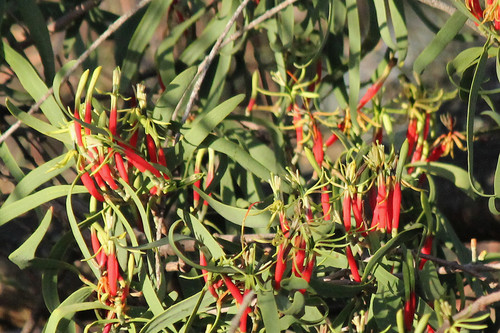
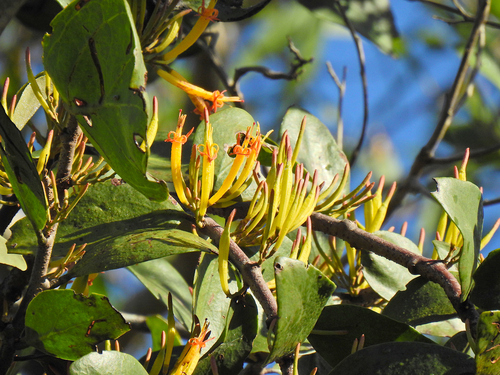
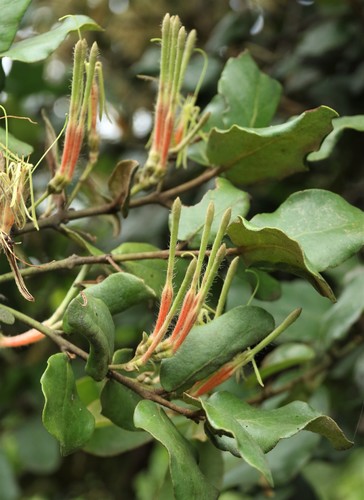
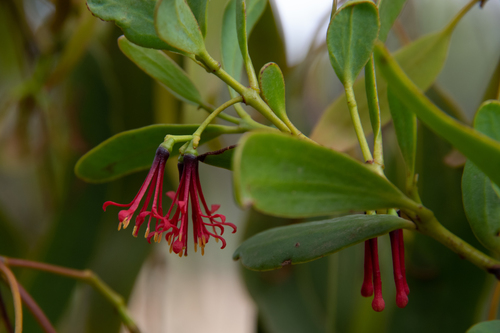
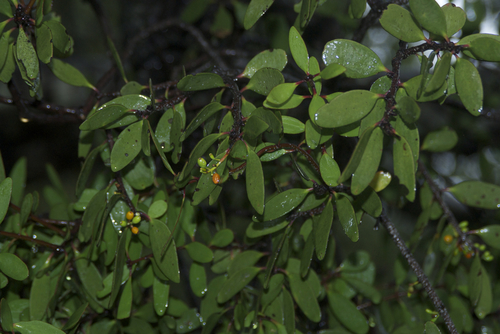
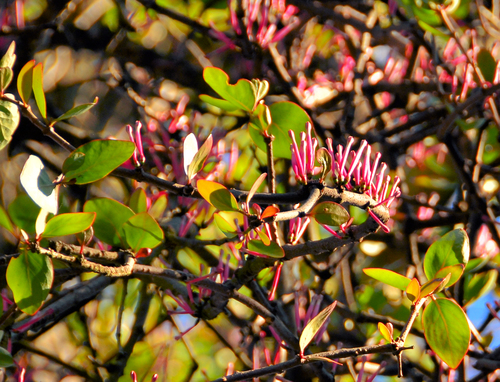
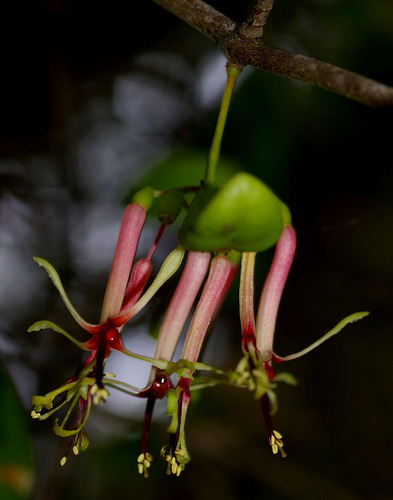
Muellerina celastroides is an erect or spreading plant that is mostly smooth, with the only exception being its inflorescence axis, which is covered in minute, brown, densely matted woolly hairs. Its leaves range from oblong to elliptic in shape, measure 2.5 to 7 cm long and 15 to 25 mm wide, and have a rounded apex and an attenuate base. The inflorescence is a raceme holding 1 to 3 pairs of triads, with the stems of the lateral flowers measuring 3 to 6 mm long. The calyx is entire and around 1 mm long. The corolla of a mature bud is 22 to 35 mm long. The anthers are around 1.5 mm long, while the free portion of the filament is 8 to 13 mm long. The fruit is pear-shaped, 7 to 11 mm long, and colored green fading to light red. In terms of ecology, the most commonly recorded hosts that M. celastroides grows on are species of Allocasuarina, Banksia, and Eucalyptus. It also frequently grows on exotic plant species and other mistletoes. A full inventory of host plants for Muellerina celastroides has been published by Downey. Muellerina celastroides acts as a host for six butterfly species: Delias nigrina, Delias argenthona, Hypochrysops digglesii, Ogyris abrota, Ogyris zosine, and Candelides margarita.