About Muehlenbeckia complexa (A.Cunn.) Meisn.
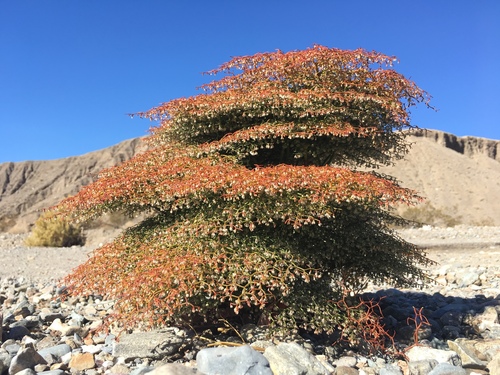
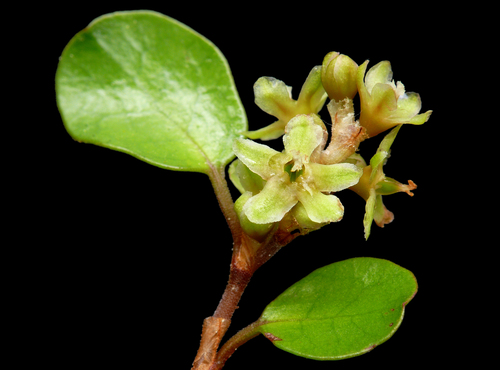
Muehlenbeckia complexa (A.Cunn.) Meisn. is a species in the Polygonaceae family. It is one of 50 species of divaricate shrubs grouped across 21 plant families; divaricate shrubs have interlaced branches and a reduced number of leaves. This divaricate growth trait is nearly unique to New Zealand, with very few divaricate species occurring elsewhere in the world. M. complexa is a vascular plant native to New Zealand. It forms a dense, thick mass of tightly interlaced branches. Its stems are slender, and they creep or twine over other plants or rocks; without external support, it will climb over its own stems to form thick, dense prostrate masses. When it grows near the shore, it frequently takes on a cushion form. Its stems are tough and woody, with red-brown bark that gives the plant a wiry overall appearance. Its leaves are petiolate, and vary in shape and size even on a single individual plant. Leaf margins may be lobed or entire. Leaves grow rather sparsely on slender stalks up to 1 cm long. Leaf blades range from 5 mm to 20 cm long and 2 to 15 mm wide. Its pleasantly scented flowers grow on spikes around 2 cm long, which emerge from leaf axils and branchlet tips. The flowers are small, dioecious, and each contains 8 stamens. As flowers age, they enlarge into succulent semi-transparent fruits, with a shiny, black, triangular seed at the center of each fruit. This species is semi-deciduous, losing most or all of its leaves over winter. M. complexa occurs naturally across all three main islands of New Zealand, and is also found on Australia's Lord Howe Island. It grows in a range of habitats across coastal, lowland, and montane regions, and it is often found growing alongside Plagianthus divaricatus, also called shore ribbonwood. It is native to New Zealand, but has become common along both the eastern and western coasts of the United States, including Hawaii. It has also been introduced to Western Australia, Mexico, the United Kingdom, Malaysia, Japan, and parts of South America. It prefers coastal climate habitats. In its native New Zealand environment, M. complexa plays a key role in recovering areas damaged by human and natural disturbances at forest edges. It also suppresses the growth of introduced weeds such as blackberry, and supports increased insect diversity. In Māori culture, the sweet, juicy succulent floral structures of this plant were eaten, especially by Māori children.