About Moxostoma poecilurum Jordan, 1877
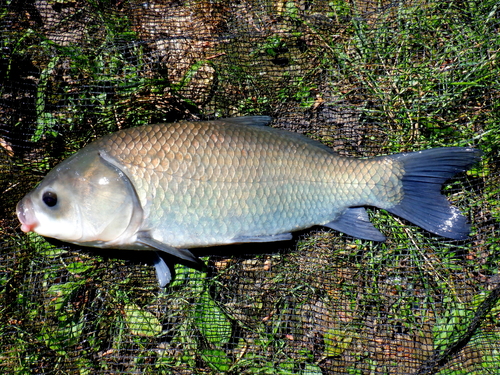
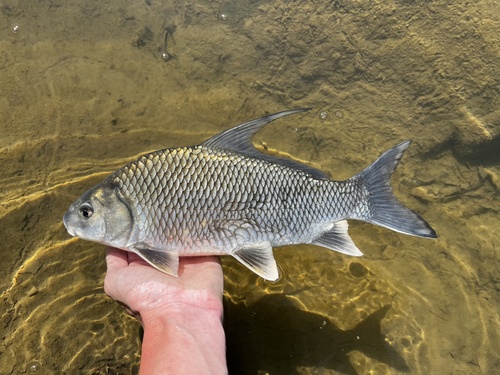
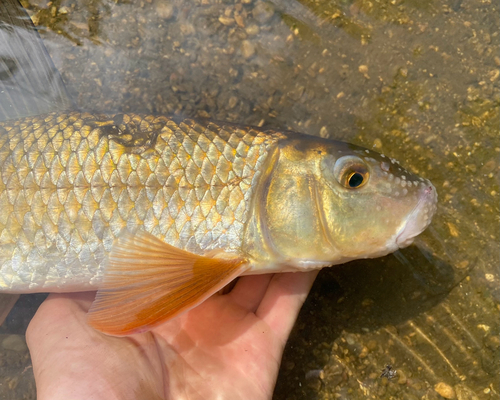
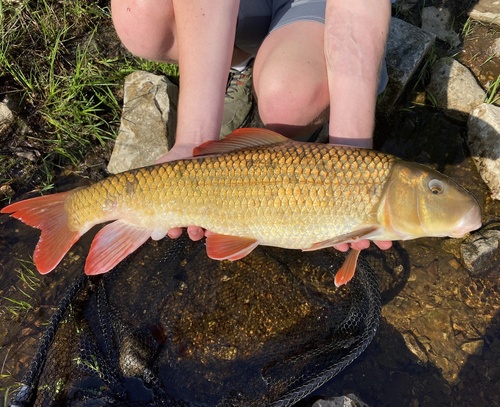
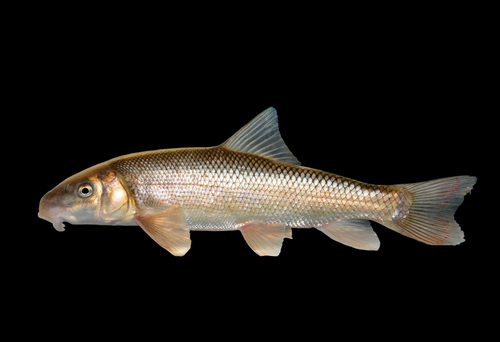
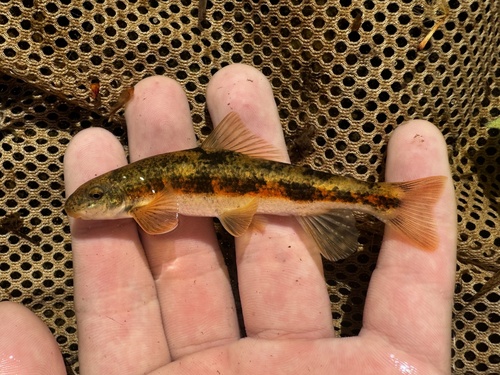
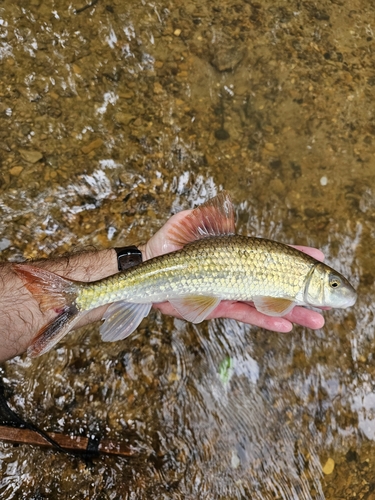
Like other members of the genus Moxostoma, the blacktail redhorse has a long, cylindrical body. Its upper half is gold to bronze with silver-green iridescence, while its lower half ranges from silvery yellow to white. The caudal fin and lower fins are red, and the forked caudal fin—which is usually larger on the lower half than the upper half—has a black stripe on its lower half. The dorsal fin typically has a concave edge; it is dusky grey on the lower half and redder on the upper half. This species usually has between 41 and 44 lateral scales, and 12 to 13 dorsal rays. The maximum total length of the blacktail redhorse is 51 cm (20 in), and most adults have a total length between 25 cm (10 in) and 41 cm (16 in). Moxostoma poecilurum occurs throughout Mississippi River tributaries located on the former Mississippi Embayment, stretching from southern Kentucky to southern Arkansas, and south as far as Louisiana. It also lives in Gulf Slope drainages from the Choctawhatchee River in Alabama and Florida to Galveston Bay in Texas, and it is endemic to the Southeastern United States. Its distribution has not experienced any notable reduction for any reason, and the species has not been extirpated from any of its historic range. This is a demersal, temperate freshwater fish, most often found in sandy and rocky pools, runs, and riffles of small to medium-sized streams and rivers. Thanks to its adaptability and wide distribution across the Southeast, it can sometimes also be found in reservoirs, swamps, and the Mobile Delta. It generally lives in water ranging from swift to standing, over substrates of sand, silt, rock, or gravel, and near aquatic vegetation. It is a benthic feeder with a relatively diverse diet that includes detritus, diatoms, and a wide variety of small invertebrates: microcrustacea, rotifers, and the larvae of many insects. A Louisiana State University study found that its diet is "primarily composed of chironomid (55%) and heptageniid larvae (17%)". Due to its relatively small size, the blacktail redhorse is a common prey species for many avian and mammalian predators. Blacktail redhorse spawn in rocky shoal areas of small streams from late April through early May, when water temperatures reach around 20 degrees Celsius. They use an aggregation spawning method: 2 to 3 males swim around one female, spawning at intervals. Fertilized eggs are demersal and nonadhesive, and they hatch 6 to 8 days after fertilization. Roughly 6 days after hatching, larvae move from the bottom into the water column. Females reach sexual maturity at around 3 years of age, with an average clutch size of 17,000 eggs. Blacktail redhorse can reach a maximum total length of 51 centimeters (20 inches), and have a maximum lifespan of 10 years. During colder months of the year, mature individuals perform seasonal migration, moving downstream into deeper water.