About Moxostoma duquesnii (Lesueur, 1817)
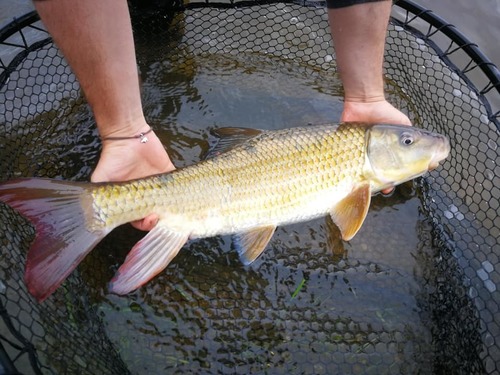
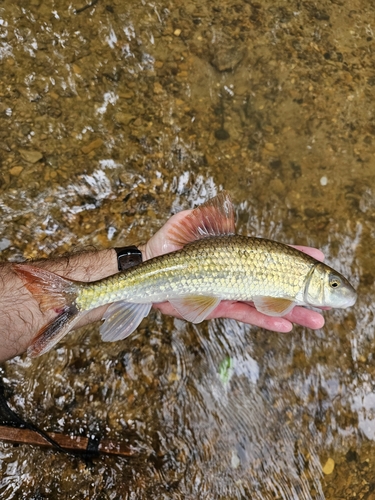
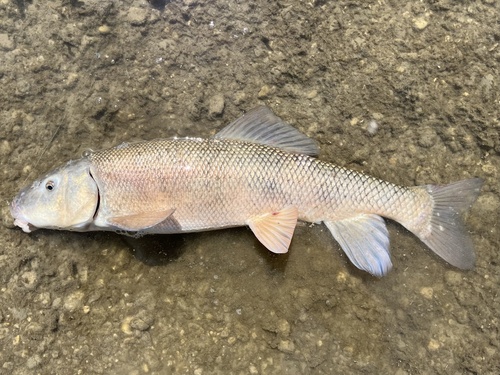
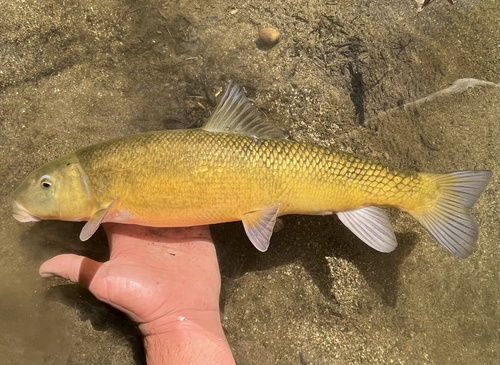
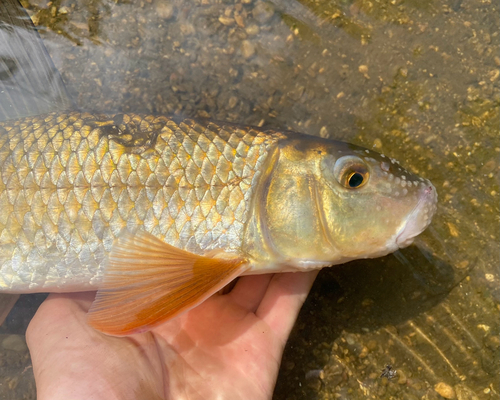
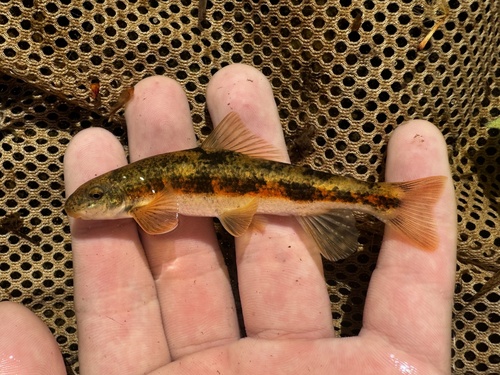
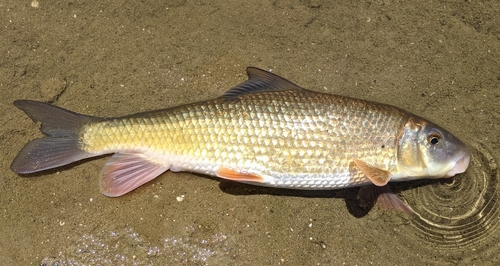
The black redhorse (scientific name Moxostoma duquesnii (Lesueur, 1817)) is a species in the sucker family, Catostomidae. This fish has a laterally compressed, shallow body with only a slight arch to its back. Almost half of its head is made up of a long, rounded snout, with the mouth positioned on the underside of the snout and featuring a thick lower lip. The body is silvery-blue overall, with a gray or brownish dorsal surface, a silver or white belly, and some scales that have dark edges. During the breeding season, males develop dark stripes and orange or pink coloration along their flanks, as well as nuptial tubercles on their tail fins. The black redhorse can be told apart from similar related species by the complete lack of red on the tail and the absence of grooving on the lips. Black redhorse have a wide but disjunct distribution across eastern North America. Their range extends from Alabama and Mississippi in the south north to Ontario and Michigan, and from New York in the east west to Oklahoma and Minnesota. In Canada, the species is restricted to southwestern Ontario, where it only occurs in six watersheds. It can be found in the Bayfield River, Maitland River and Ausable River watersheds within the Lake Huron drainage; in the Catfish Creek (where it is now extirpated) and Grand River watersheds within the Lake Erie drainage; and in the Thames River watershed within the Lake St. Clair drainage. Black redhorse most commonly inhabit moderately sized rivers and streams that are 25 to 130 m (82 to 427 ft) wide, up to 1.8 m (5 ft 11 in) deep, and generally have moderate to fast currents. They are almost never found in areas with abundant aquatic vegetation. Common substrate types in their habitats include rubble, gravel, sand, boulders and silt. In summer, they typically occupy pools, and they overwinter in deeper pools. In spring, black redhorse migrate to spawning habitats. They spawn in spring in riffle habitats at water temperatures between 15 and 21 °C (59 and 70 °F), over substrates ranging from fine gravel to large cobble. Their eggs are nonadhesive, and measure between 2.6 to 2.9 mm (3⁄32 to 1⁄8 in) across. Black redhorse reach maturity between two and six years of age. Their maximum lifespan increases with latitude, and some individuals can live up to 16 years.