About Moxostoma anisurum (Rafinesque, 1820)
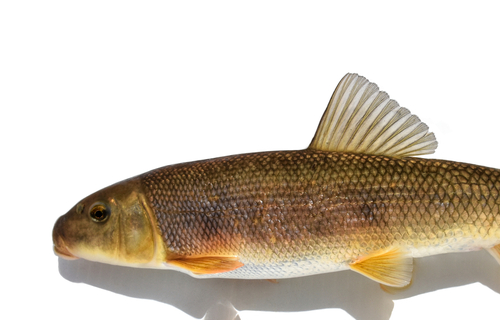
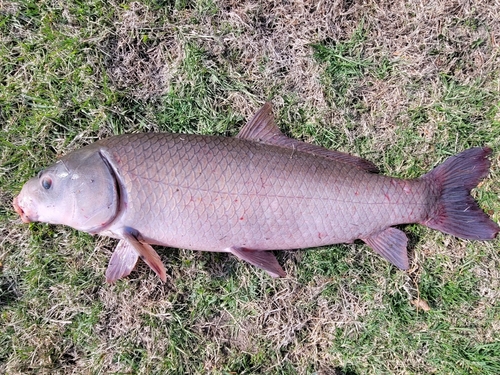
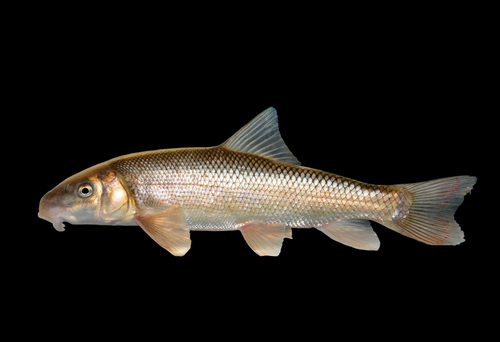
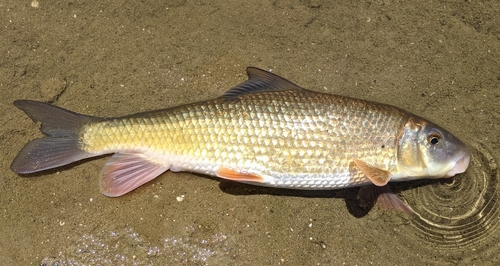
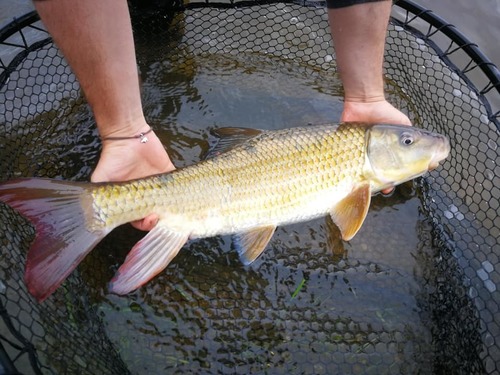
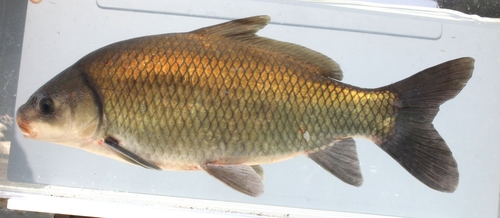
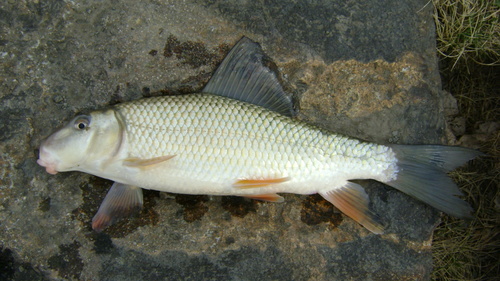
Morphology: The silver redhorse (Moxostoma anisurum) has silver sides, a dark gray-brown back, and a slate gray tail. Its caudal fin is large, moderately forked, and has two equal-sized, pointed lobes. There are 41–42 cycloid lateral line scales along its silver sides. It has a single dorsal fin located roughly in the middle of its back, which has no dorsal spines but 14–17 soft rays, and a slightly convex (outward rounded) outline. No adipose fin (the unstructured fin located behind the rayed dorsal fin) is present on its back. As a bottom feeder, the silver redhorse has an inferior-positioned mouth, and the rear edge of its lips forms a deep "V". Due to extremely similar appearance, the silver redhorse is often confused with the black redhorse and golden redhorse. However, both of these related species have slightly concave dorsal fins (curving inward toward the body) with only 12–14 fin rays. Additionally, the silver redhorse has a deeper body than either the golden or black redhorse. It typically weighs 2–5 pounds (0.91–2.27 kg) and measures 18–24 inches (46–61 cm) long, though it can reach a maximum size of 10 pounds (4.5 kg) and 30 inches (760 mm).
Geographic distribution: The native range of the silver redhorse covers the Great Lakes, and the St. Lawrence and Mississippi River basins. It has also been recorded in Clayton Lake and the New River Drainage in North Carolina. This species is widely distributed across eastern North America from Missouri to Quebec, with most populations located in the southeastern United States.
Habitat: It typically inhabits lakes and small to large rivers, where it is often found around undercut banks or protruding tree roots. It also occurs in deep pools with little to no current, that have a sand substrate on the bottom which is useful for burying its eggs. It cannot tolerate murky water, so it serves as a good indicator of water quality.