About Motacilla maderaspatensis Gmelin, 1789
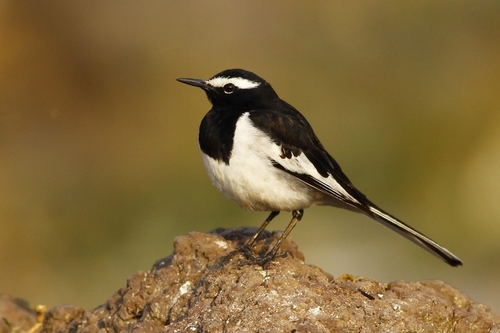
Description: The white-browed wagtail (scientific name Motacilla maderaspatensis Gmelin, 1789) is the largest wagtail species, reaching 21 cm (8.3 in) in length. It is a slender bird with the characteristic long, constantly wagging tail shared by all members of its genus. Adults have black upperparts, head, and breast, along with a white supercilium and a large white wingbar. Unlike white wagtails, this species never has white plumage on the forehead. The remaining parts of the underparts are white. Female white-browed wagtails have less intense black plumage than males. Juveniles resemble females, with brown-grey colouring in the areas where adult birds have black plumage.
Distribution and habitat: The white-browed wagtail is a resident breeding bird endemic to the Indian subcontinent. Its range covers areas south of the Himalayas, east of the Indus river system, and west of Bangladesh. It is rare at higher altitudes, but has been observed in Ladakh on the edge of the Tibetan plateau. Across most of India, it occurs below 1000 m, but in southern India it can be found in hills up to 2200 m. It is very rare in the Indus valley area, and is completely absent from the Sind region of Pakistan. It inhabits open freshwater wetland habitats. It is one of the few Motacilla wagtails that has adapted well to urban habitats, and is often seen perched on overhead water storage structures in residential areas. It is a rare winter visitor to Sri Lanka, and may have expanded its range in recent times.
Behaviour and ecology: This species is usually seen in pairs or small groups near open water. It calls frequently, especially in the morning, and is active like most other wagtails. It perches on the ground, as well as on wires and buildings. Its song is long, loud, and made up of many different notes. Its most common call is a wheezy "wheech". It can fly fairly quickly over long distances, with a characteristic bounding flight pattern that alternates between dipping and rising, and has been recorded reaching flight speeds of around 40 km/h. Endoparasitic filarial parasites of the species Splendidofilaria singhi have been documented in individual white-browed wagtails.
Food: Like other wagtails, the white-browed wagtail is insectivorous. Nestlings are mainly fed orthopterans, caterpillars, and spiders. Staphylinid beetles and pentatomid bugs have also been recorded as part of the species' diet. It has adapted to urban environments, where it may find water primarily as overflow from rooftop storage tanks.