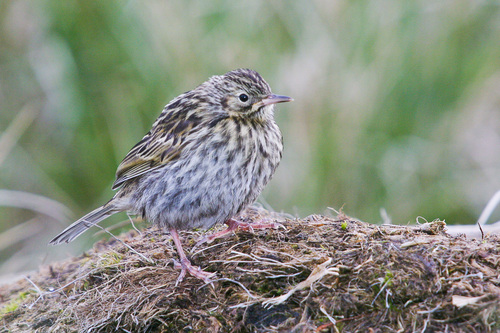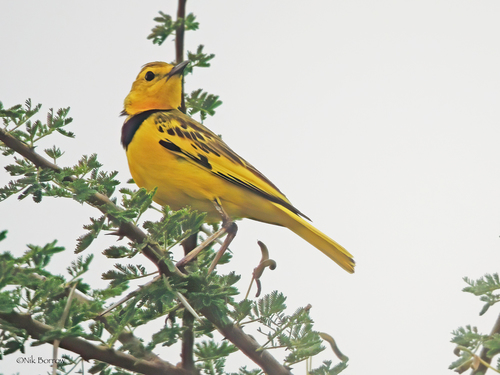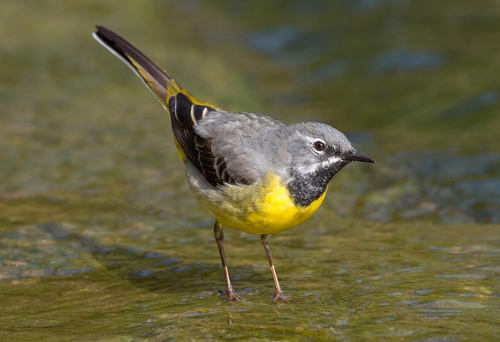
About Motacilla cinerea Tunstall, 1771
This slim wagtail species has a narrow white supercilium and a broken eye ring. Its upperparts are grey, and the yellow vent contrasting against whitish underparts makes it distinctive. Breeding males have a black throat edged by whitish moustachial stripes. Grey wagtails forage singly or in pairs on meadows or shallow water marshes. They also use rocks in water and often perch on trees. They have a clear, sharp call note, and their song is made up of trills. This bird is widely distributed across the Palearctic region, with several distinct populations. The nominate form, which includes the caspica population from Iran, Turkey and the Caucasus, occurs in western Europe including the British Isles, Scandinavia and the Mediterranean region. The race melanope, which is not well separated from the nominate subspecies, describes the population that breeds in eastern Europe and central Asia, mainly along the mountain chains of the Urals, Tien Shan, and the Himalayas, and winters in Africa and Asia. The race robusta breeds in northeastern parts of Asia in Siberia, extending to Korea and Japan, and winters in Southeast Asia. Recognized island forms include patriciae of the Azores, schmitzi of Madeira, and canariensis of the Canary Islands. This species sometimes occurs on islands west of Alaska, and has been recorded as a vagrant further south in California. The breeding season runs from April to July, and nests are placed near fast-running streams or rivers, on embankments between stones and roots. In Europe, nests are often built in holes in manmade structures. During display, the male makes short flights up into the air, then descends slowly with fluttering flight, accompanied by a rapid series of high, chipping notes. Clutches consist of 3 to 6 speckled eggs, and multiple broods may be raised, with clutch sizes decreasing in subsequent broods. In Ireland, the usual clutch size is five, and breeding success is around 80%, with predation of eggs or chicks being the main cause of breeding failure. Populations in the Canary Islands typically have smaller clutches, and their breeding season is not as short or well-defined as that of populations at higher latitudes. The incubation period is about two weeks, and chicks fledge within a fortnight. In the wild, these birds live for a maximum of 8 years. In some parts of its range, the white-throated dipper nests in the same habitats as the grey wagtail, and there are recorded observations of adult grey wagtails feeding dipper chicks between species. These birds feed on a variety of aquatic invertebrates, including adult flies, mayflies, beetles, crustacea, and molluscs. In winter, they often forage along roadsides; when flushed, they give a sharp chi-cheep call, fly further up the road, then after some distance turn back to return to their original location. In winter, they roost in small groups. Wintering birds have been recorded returning to the same sites each year, sometimes small urban gardens. Adult grey wagtails often carry the parasitic tick Ixodes ricinus, which can harbour Borrelia, so the species may potentially disperse Lyme disease across a wide region. Coccidia of the genus Isospora are also known to occur in this species. The common cuckoo sometimes acts as a brood parasite on this species, and kestrels may occasionally prey on grey wagtails.