About Motacilla alba Linnaeus, 1758
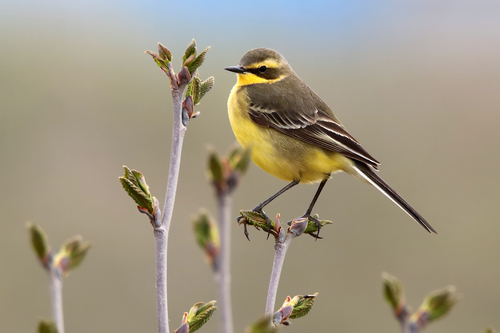
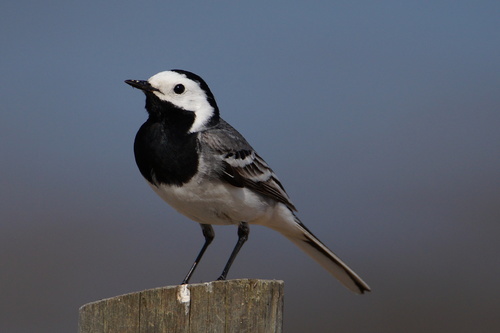
The white wagtail (Motacilla alba Linnaeus, 1758) is a slender bird, with a total length of 16.5 to 19 cm (6.5 to 7.5 in). East Asian subspecies are slightly longer, reaching up to 21 cm (8.3 in). It has the characteristic long, constantly wagging tail shared by all members of its genus. Its average weight is 25 g (0.88 oz), and the maximum recorded lifespan in the wild is around 12 years. A number of additional subspecies exist, some of which likely formed due to partial geographical isolation. One example is the non-migratory British and Irish subspecies, the pied wagtail M. a. yarrellii, which now also breeds in adjacent areas of the nearby European mainland. Named for naturalist William Yarrell, the pied wagtail replaces the pale grey back color of the nominate subspecies with black in males, and dark grey in females and juveniles, but has identical behavior otherwise. Other subspecies, some of which have questionable taxonomic validity, differ in the coloration of the wings, back, head, or other features. Some subspecies exhibit sexual dimorphism during the breeding season. As many as six different subspecies may occur on wintering grounds in India or Southeast Asia, where they can be very hard to tell apart. Phylogenetic studies using mitochondrial DNA suggest that some morphological features, including back and chin color, have evolved more than once. Breeding M. a. yarrellii are very similar to the nominate race except for their black back, and M. a. alboides from the Himalayas only differs from Central Asian M. a. personata by its black back. M. a. personata has been recorded breeding in the Siddar Valley of Kashmir in the Western Himalayas. It has also been observed that both back and chin color change during the pre-basic moult: all black-throated subspecies develop white chins and throats in winter, and some black-backed birds become grey-backed in winter. The white wagtail’s call is a sharp chissick, which is slightly softer than the call given by the pied wagtail subspecies. The song of the white wagtail is more regular than that of the pied wagtail, and it has little territorial significance, because males use a series of contact calls to attract females. This species breeds across most of Eurasia, as far north as 75°N latitude, and is only absent from Arctic regions where the July isotherm is lower than 4 °C. It also breeds in the mountains of Morocco and in western Alaska. It occupies a wide variety of habitats, but does not occur in deserts. White wagtails are year-round residents in milder parts of their range such as western Europe and the Mediterranean, but are migratory across most of the rest of their range. Northern European breeding populations winter around the Mediterranean and in tropical and subtropical Africa, while Asian populations move to the Middle East, India, and Southeast Asia. Birds from the North American population also winter in tropical Asia. The most noticeable habit of this species is its near-constant tail wagging, a trait that gives both the species and its genus their common name. Despite how widespread this behaviour is, its purpose is not well understood. It has been proposed that the wagging may flush out prey, or signal submissiveness to other wagtails. A 2004 study suggested instead that it acts as a signal of vigilance to potential predators.