About Morus rubra L.
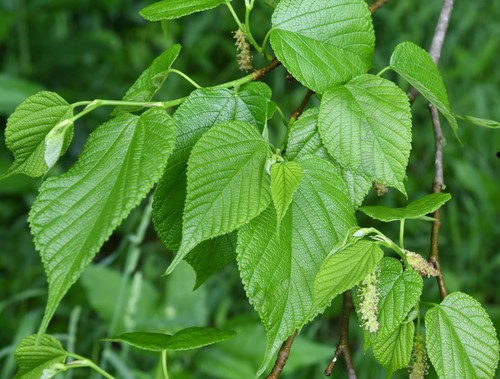
Morus rubra L., commonly known as red mulberry, is a small to medium-sized deciduous tree. It typically grows 10–15 meters (35–50 feet) tall, reaching a maximum rare height of 21 meters (70 feet), with a trunk up to 50 centimeters (20 inches) in diameter, and can live up to 125 years. Its leaves are alternate, simple, and broadly cordate with a shallow notch at the base and a finely serrated margin. They are usually 7–18 cm (2+3⁄4–7 in) long (rarely up to 36 cm or 14+1⁄4 in) and 8–12 cm (3+1⁄4–4+3⁄4 in) wide, about twice the size of white mulberry (Morus alba) leaves. Mature trees typically bear unlobed leaves, while young trees often have 2–3 lobes per leaf. Unlike the lustrous upper leaf surface of white mulberry, red mulberry has a noticeably rough upper leaf texture similar to fine sandpaper, with a soft-haired dense underside. When the leaf petiole is cut, it releases milky sap, and leaves turn yellow in autumn. The flowers are small, yellowish green or reddish green, relatively inconspicuous, and open as new leaves emerge. Male and female flowers are usually on separate trees, though they can occasionally grow on the same tree. The fruit is a compound cluster of small achenes surrounded by a fleshy calyx, shaped like a blackberry and 2–3 cm (3⁄4–1+1⁄4 in) long. It starts pale green and ripens to red or dark purple. Red mulberry develops an extensive root system: large lateral horizontal roots grow in the upper 24 inches of soil, and smaller vertical roots branch off these lateral roots. This root structure provides stability and lets the tree take up nutrients from the nutrient-rich top soil layer. It is hardy to subzero temperatures, and relatively tolerant of drought, pollution, and poor soil, though it is less hardy than white mulberry. Pollination occurs via wind. In North America, birds widely seek out its berries in spring and early summer; up to 31 bird species have been recorded visiting a single fruiting tree in Arkansas. According to the National Register of Champion Trees, the largest living red mulberry is located in Hamburg, Arkansas, measured in 2018 at 75 feet tall, with a 305-inch trunk circumference and an average crown spread of 71 feet. Red mulberry is native to the United States, with a range stretching from the Atlantic coast to the eastern edge of the Great Plains, south to southern Florida, and north to southwestern Ontario, Canada. It grows most often in riparian areas, and is considered rare and threatened across many regions, including the northeastern United States and southeastern Canada. The morphologically similar introduced white mulberry (M. alba) threatens red mulberry populations, due to its rapid range expansion, aggressive growth, and reproductive advantages over M. rubra. Red mulberry is currently listed as endangered in Canada, and in the U.S. states of Connecticut and Massachusetts; it is listed as threatened in Michigan and Vermont. The berries of red mulberry are edible and sweet. In 1607, the first English colonists to explore eastern Virginia noted that native Powhatan tribes ate the abundant mulberry fruit, sometimes after boiling. Today, people eat the berries raw, use them as pastry filling, ferment them into wine, and process them into marmalades and liquors. They are also used to make natural dyes and cosmetics. Berries are not sold commercially because they have a very short shelf life and do not pack or ship well. The wood can be dried to smoke meats, producing a mild, sweet flavor. It is also used for fence posts because its heartwood is relatively durable. Additional wood uses include farm implements, cooperage, furniture, interior finishing, and caskets. For cultivation, early pruning is required to help the tree develop a sturdy framework. After this early stage, pruning mostly involves removing dead or overcrowded wood. To keep the tree tidy, it is recommended to select a few main branches and cut laterals to six leaves in July, which encourages spur development close to the main branches. Red mulberry tends to bleed after pruning, so pruning should be kept to a minimum and done while the tree is dormant, when bleeding is less severe. Cutting branches larger than 2 inches in diameter should be strictly avoided. When tilling soil around the tree, care must be taken not to damage the horizontal roots, as cutting them will impair the tree's nutrient uptake. In a red mulberry's first year, sufficient water is critical for healthy root system development: young trees growing in light soil should be watered thoroughly twice a week, while those in clay soil should be watered thoroughly once a week. Mature trees are drought tolerant, but water scarcity can cause early fruit drop and reduce berry yields, so irrigation is recommended for fruit production during dry periods. Mulching helps retain soil moisture and reduces competition from grass and weeds, so it is recommended around mulberry trees. Mulch should not touch the tree's stem, as this can cause stem rot. Red mulberry thrives with little to no fertilizer. Fertilizing more than twice a year should be avoided, and fertilizing after July can increase risk of freeze damage. A balanced 10-10-10 NPK fertilizer is recommended, with additional nutrients such as iron added based on existing soil nutrient levels. Red mulberry is usually free of major pests and diseases, but popcorn disease may occur in some regions. If this disease appears, infected fruits should be collected and burned to prevent pathogen reproduction and overwintering. Depending on the variety, red mulberry can be monoecious (with male and female flowers on the same tree) or dioecious (with male and female flowers on separate trees); for fruit production, both male and female plants must be grown if a dioecious variety is selected. To harvest fruit, branches are typically shaken and fallen fruit is collected by hand. Red mulberry has not been widely cultivated across most of the world, due to a number of limitations. Unlike white mulberry, it cannot be used for silk production because silkworms will not eat its leaves. Trees do not produce fruit until around 10 years after planting, and maximum yields are only achieved after 30 to 85 years, so planting for commercial berry production requires a long-term investment before any economic return. Even with its general drought tolerance, drought stress to roots causes premature fruit drop. Fruits are delicate, which complicates packing and shipping. Sensitive people can develop dermatitis from touching the leaves, stem, or unripe fruits. Leaf sap and unripe fruits can even cause hallucinations and central nervous system disturbances. Fruits attract many species of birds and mammals, so commercial fruit production requires costly, complex pest prevention for these large trees. Long generation times also make breeding programs very slow. While red mulberry is resistant to many pathogens, it can still be affected by certain diseases and pests. Common issues include mulberry leaf spot, bacterial blight caused by the bacterium Pseudomonas syringae pv. mori, powdery mildew caused by the fungi Phyllactinia corylea and Uncinula geniculata, and various root rot diseases.