About Morus bassanus (Linnaeus, 1758)
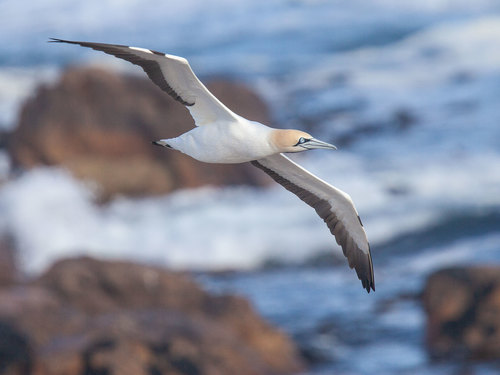
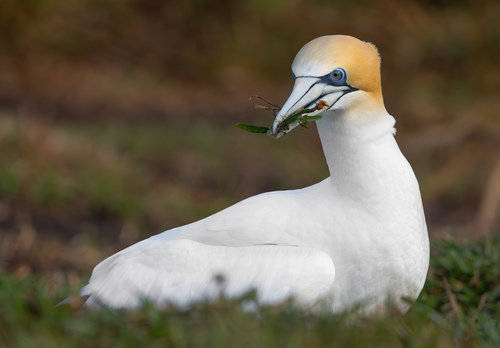
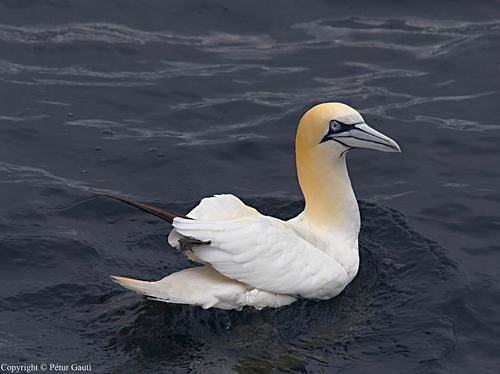
The northern gannet, with the scientific name Morus bassanus (Linnaeus, 1758), is the largest gannet species and the largest seabird native to the western Palearctic. Adult northern gannets measure 87–100 cm (34+1⁄2–39+1⁄2 in) in length, have a 170–180 cm (67–71 in) wingspan, and weigh 2.3–3.6 kg (5–8 lb). Males and females are generally similar in size and appearance. Their plumage is white with dark brown to black wing tips; the primary flight feathers, primary coverts, and alulae are all dark. The head and neck have a buff-yellow tint that grows much more prominent during the breeding season, and males have deeper colouring than females. A ring of black bare skin surrounds the eyes, which also feature a cobalt blue orbital ring. The iris is light blue-grey with a fine dark outer ring, though irises turn black in birds that survive avian influenza. The beak is long, strong, and conical, with a slight downward curve at the tip and a sharp cutting edge. Adult beaks are blue-grey with dark grey or black edges. A black groove runs the full length of the mandible, and merges into the skin around the eyes. A black band of bare skin separates the pale feathers of the forehead and throat from the bill, forming the species' distinctive face marking. All four toes on the feet are connected by webbing, which ranges in colour from dark grey to dark brown. Coloured lines run along the toes and continue up the legs: these lines are typically greenish-yellow in males and bluish in females, and are thought to play a role in mating. Fledgling northern gannets are dark grey to slate-grey, with fine white speckling on their upperparts and wings. They have a prominent V-shaped white area under the rump, dark brown-black wing tips and tail with partial white tipping, and dark brown bills and irises. Fledglings can weigh more than 4 kg (9 lb) when they leave the nest at around 10 weeks old. In their second year, their appearance changes based on different moulting phases, and they may have adult-style plumage on the front of their body while remaining brown on the rear. Gannets gradually grow more white plumage each season after that, and do not reach full maturity until they are five years old. Compared to Cape gannets and Australian gannets, northern gannets are slightly larger, have thicker bills, have more white plumage on their wings, and have an all-white tail, while the other two species have black-tipped tail feathers. Northern gannets found along the west coast of Africa could be mistaken for vagrant masked boobies, but masked boobies are smaller overall, have no buff tint on the head, and have a black tail. From a distance or in poor visibility, albatrosses can be confused with northern gannets, especially immature northern gannets that have more black colouring on the wings. The breeding range of the northern gannet spans both sides of the North Atlantic, on coasts influenced by the Gulf Stream. Colonies exist in the Gulf of Saint Lawrence and on islands off the east coast of Canada. They normally nest in large colonies, on cliffs that overlook the ocean or on small rocky islands. The water in their habitat must be cool enough to support Atlantic mackerel and herring, the northern gannet's main food source, and these habitats lie over the continental shelf. Northern gannet colonies can exist in the far north in very cold, stormy regions. Researcher Nelson has suggested multiple reasons the species can survive in these regions: their combination of body weight and a powerful beak allows them to catch strong muscular fish, they can dive to great depths to capture prey far from nesting cliffs, their fat reserves act as added weight during diving and serve as energy stores during extended periods without food. The northern limit of their breeding range depends on the presence of sea ice-free water during the breeding season. Even though Greenland and Svalbard have otherwise suitable breeding sites, Arctic regions there have summers too short to support the full 26 to 30 week period northern gannets need to lay eggs and raise their young. The southern limit of their distribution depends mainly on the presence of enough prey. Fossil evidence shows that northern gannets bred on Crete during the Pleistocene.