About Morone saxatilis (Walbaum, 1792)
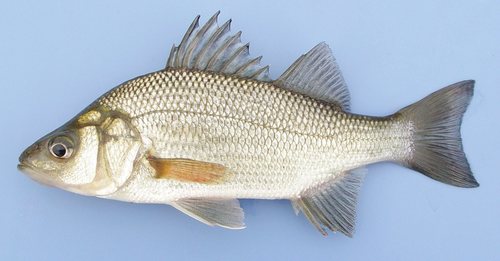
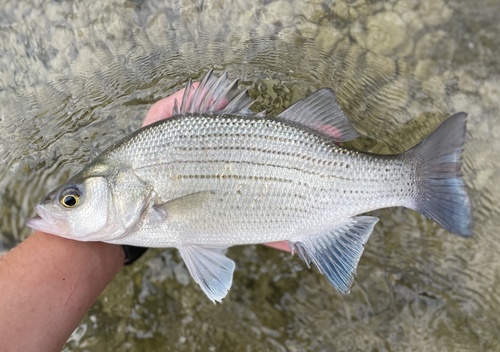
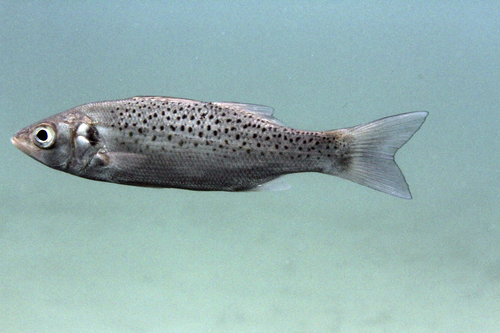
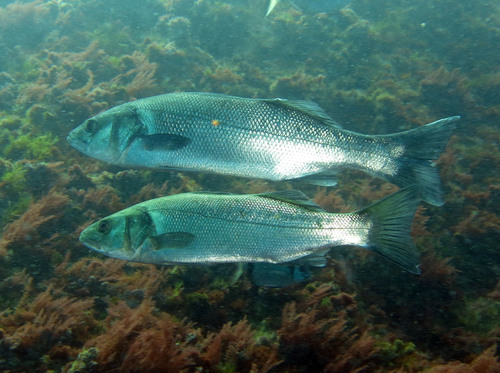
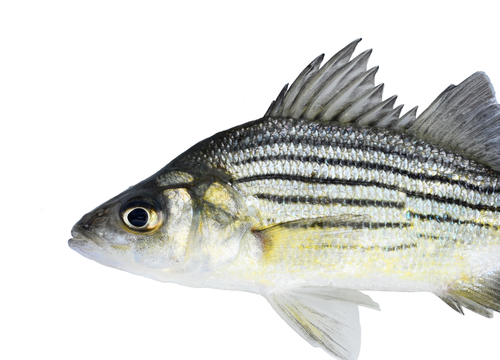
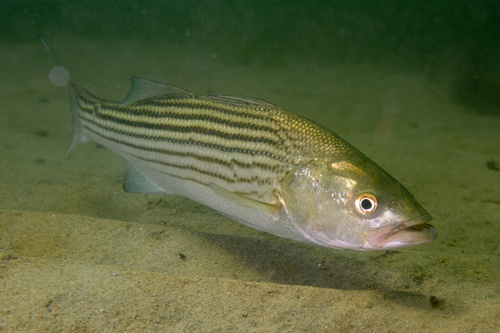
Morphology and lifespan: The striped bass (scientific name Morone saxatilis (Walbaum, 1792)) has a shape typical of the Moronidae family, with a streamlined, silvery body marked by longitudinal dark stripes that run from behind the gills to the base of the tail. Common mature individuals weigh 20 to 40 pounds (9–18 kg). The largest recorded specimen weighed 124 pounds (56 kg) and was netted in 1896. Striped bass are thought to live up to 30 years. The average length of an adult is 20 to 35 inches (50–90 cm), with an approximate weight of 5 to 20 pounds (2–9 kg), but average size varies based on the fish's age and sex. Natural distribution: Striped bass are native to the Atlantic coastline of North America, ranging from the St. Lawrence River south into the Gulf of Mexico to Louisiana. They are anadromous fish, meaning they migrate between fresh and salt water, and spawning occurs in fresh water. Introductions outside their natural range: State game and fish commissions have introduced striped bass to the Pacific Coast of North America and to many large reservoir impoundments across the United States, both for recreational fishing and as a predator to control gizzard shad populations. Documented introduction locations include: Elephant Butte Lake in New Mexico; Lake Ouachita and Lake Norman in North Carolina; Lake Norfork, Beaver Lake and Lake Hamilton in Arkansas; Lake Thunderbird in Illinois; Lake Pleasant and Lake Havasu in Arizona; Lake Powell along the Arizona/Utah border; Castaic Lake, Pyramid Lake, Silverwood Lake, Diamond Valley Lake, and the San Francisco Bay-Delta in California; Lewis Smith Lake in Alabama; Lake Cumberland in Kentucky; Lake George in Florida; Lake Murray in South Carolina; Lake Lanier in Georgia; Watts Bar Lake in Tennessee; Lake Mead, Nevada; Lake Texoma on the Texas and Oklahoma border, Lake Tawakoni, Lake Whitney, Buffalo Springs Lake, Possum Kingdom Lake, and Lake Buchanan in Texas; Raystown Lake in Pennsylvania; Lake Wallenpaupack in Northeastern Pennsylvania; Umpqua River in Oregon; and Smith Mountain Lake and Leesville Reservoir in Virginia. Striped bass have also been introduced to waters in Ecuador, Iran, Latvia, Mexico, Russia, South Africa, and Turkey, primarily for sport fishing and aquaculture. Life cycle: Striped bass spawn in fresh water. While they have adapted successfully to permanent freshwater habitat, they naturally spend their adult lives in saltwater, so they are classified as anadromous. Five major bodies of water that host breeding stocks of striped bass are the Miramichi River, Chesapeake Bay, Massachusetts Bay/Cape Cod, Hudson River, and Delaware River. Up until the 1860s, many rivers and tributaries emptying into the Atlantic once supported breeding striped bass populations. Chesapeake Bay is one of the largest breeding areas, where populations from Chesapeake and Delaware bays have intermingled. Very few spawning populations of landlocked freshwater striped bass exist successfully; these are found in Lake Texoma, Lake Weiss (Coosa River), the Colorado River and its reservoirs downstream of and including Lake Powell, the Arkansas River, and South Carolina's Lake Marion, which retained a landlocked breeding population after its dam was built. All other freshwater striped bass fisheries require annual restocking with hatchery-produced fish. Stocking of striped bass at Lake Mead was discontinued in 1973 after natural reproduction was confirmed. Culinary use: Striped bass has white flesh with a mild flavor and medium texture. Its flesh is extremely versatile for cooking: it can be pan-seared, grilled, steamed, poached, roasted, broiled, sautéed, deep fried (including batter-frying), eaten raw, or pickled. Fresh striped bass is most commonly sold headed and gutted (with head and organs removed) or as filets; frozen striped bass is most commonly sold headed and gutted or as loins. It can also be purchased as steaks, chunks, or whole. Fresh striped bass is available year-round, typically sold in sizes from two to fifteen pounds, and may be sold in sizes up to fifty pounds. Striped bass has firm, flavorful flesh with a large flake. Hybrid striped bass produces more meat, with a more fragile texture and a blander flavor than wild striped bass. The fish has a mild and distinctive flavor. In recipes, striped bass can be substituted for mild fish like cod, as well as for stronger-flavored fish like bluefish. A variety of other fish can be substituted for striped bass, including weakfish, tilefish, blackfish, small bluefish, catfish, salmon, swordfish, and shark. Striped bass fillets are easy to grill, so the fish is popular in beach communities. In Virginia, anadromous striped bass caught from Chesapeake Bay and its small tidal tributaries have been found contaminated with polychlorinated biphenyls (PCBs), which has led the Virginia Department of Health to issue a fish consumption advisory for these fish.