About Morone mississippiensis Jordan & Eigenmann, 1887
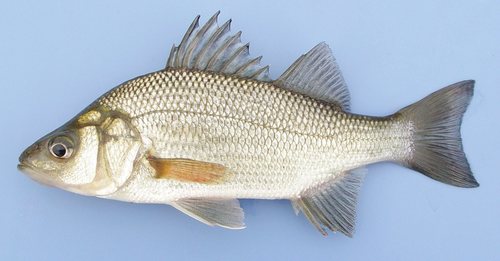
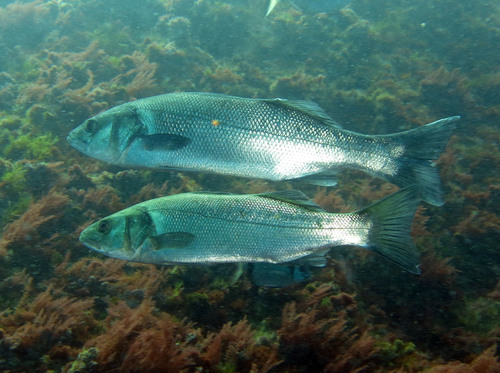
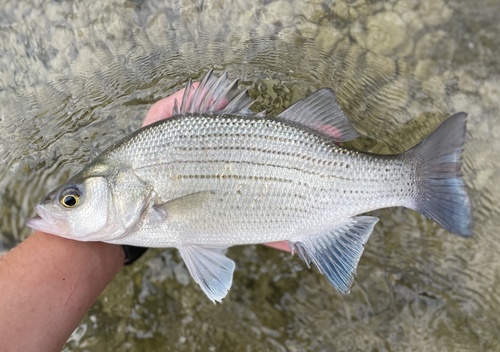
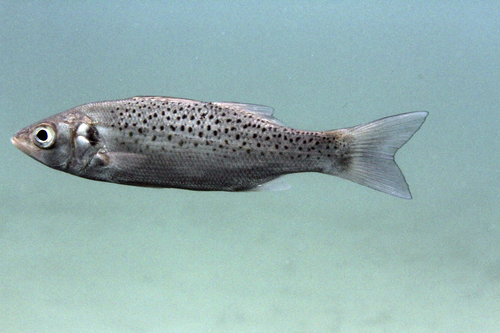
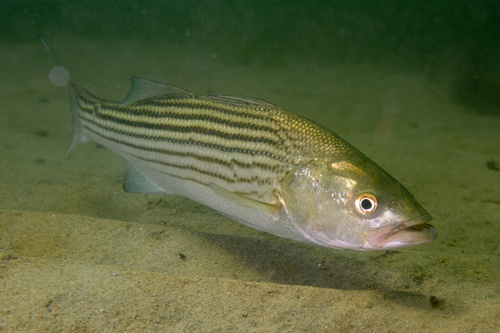
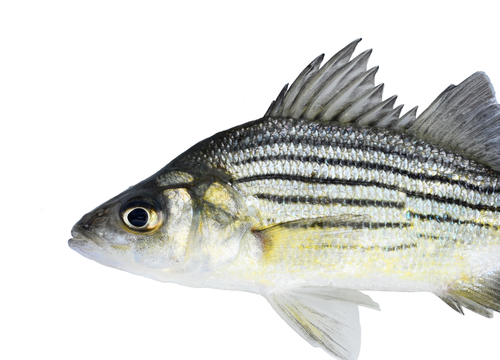
The yellow bass, scientifically named Morone mississippiensis, belongs to the family Moronidae. It is a deep-bodied fish marked with five to seven dark stripes running laterally along its sides; the lowest few of these stripes are often broken or disrupted in the area forward of the anal fin origin. This species shares some similarities with two other Moronidae members: the white bass and the striped bass. Yellow bass can be told apart from both species by its offset lateral stripes above the anal fin, and by its lack of tooth patches on the tongue. It can also be distinguished from white bass by its count of nine to ten anal rays, while white bass have eleven to thirteen. The back of a yellow bass is typically dark olive green, and its abdomen and sides are usually silvery yellow. Yellow bass occurs in the relatively clear waters of the Mississippi River, ranging from Minnesota to Louisiana, and can also be found in the Trinity River and the Tennessee River. It also inhabits lakes adjacent to these rivers, particularly in areas with dense vegetation and low turbidity, and may move into brackish estuaries. The reproductive biology of yellow bass is similar to that of white bass: spawning takes place in spring, when adult fish swim up tributaries on spawning runs. Spawning typically happens in moderately shallow water; during the act, the female positions herself on her side to expose her eggs, while the male fertilizes them from above. Yellow bass larvae school together to avoid predation, and they grow to adult size fairly quickly. The average lifespan of a yellow bass is about six years.