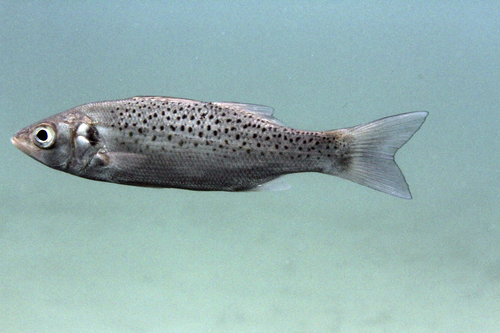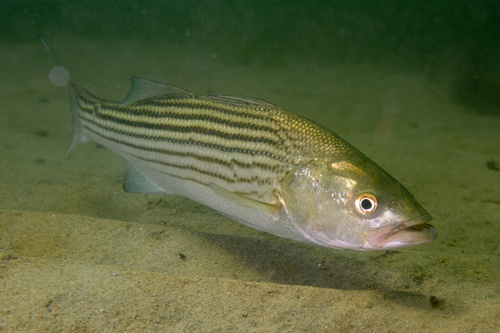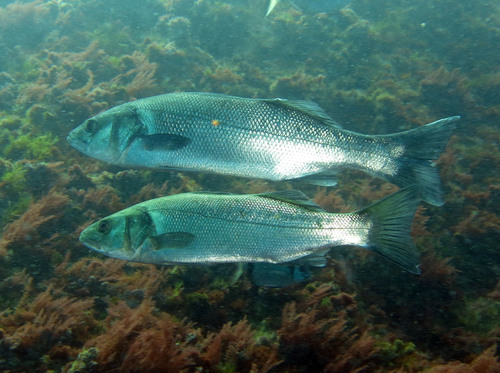
About Morone chrysops (Rafinesque, 1820)
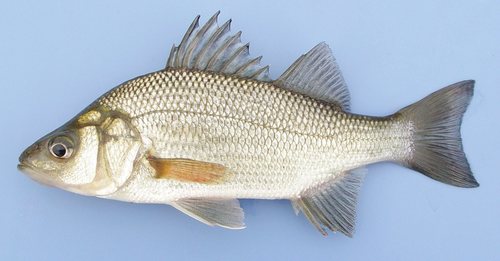
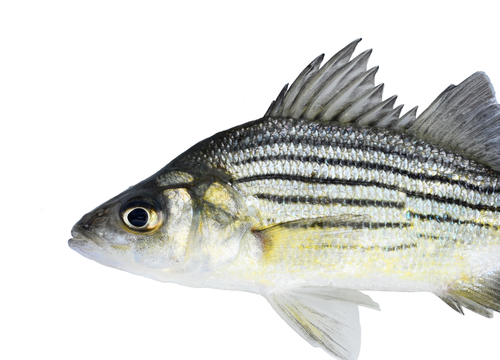
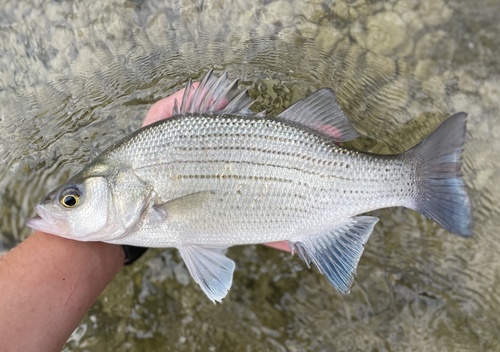
Morone chrysops, commonly known as white bass, is primarily silver-white to pale green in color. It has a dark back, white sides and belly, and narrow dark stripes running lengthwise along its sides. It has large, rough scales and two separate dorsal fins. The more anterior (front) dorsal fin is much stiffer, with structures called spinous rays; while these are not true spines, this fin is harder than the second. The posterior (rear) dorsal fin is much softer, so it is called a soft-ray. White bass can be told apart from white perch (Morone americana) by their separated dorsal fins: in white perch, the spinous and soft portions of the dorsal fin are united, and both portions raise together when the spinous portion is extended. White bass have a homocercal tail, meaning their vertebrae do not extend into the tail. Their body is deep and compressed laterally, and their tail is notched, as the dorsal and ventral edges of the tail angle inward toward a point to form a distinct angle. Most adult white bass grow to between 10 and 12 inches (25 and 30 cm) in length, though they can reach 17 inches (43 cm) or more. According to the International Game Fish Association, the all-tackle record white bass caught by recreational fishing weighs 3.09 kilograms (6 lb 13 oz), a record shared by two fish: one caught in 1989 at Orange Lake in Orange, Virginia, and another caught in 2010 in the Amite River, Louisiana. White bass are widely distributed across the United States, especially in the Midwest. They are very abundant in Pennsylvania, the region surrounding Lake Erie, the Winnebago lakes system of Wisconsin, and Oklahoma. Their documented native ranges include the Arkansas River, western Lake Erie, the Detroit River, and Lake Poinsett in South Dakota. They also occur in rivers that drain into the Mississippi River. While native to many northern North American habitats, white bass have been introduced to many other bodies of water across the United States, particularly in southern locations. Starting in the 1960s, they were successfully introduced to Manitoba, where they have become an important sport fish. White bass occur in high densities in the upstream segment of rivers, which is also the most degraded river segment due to the high diversity of fish species that live there. The spawning season for white bass runs from mid-March to late May, with optimal water temperatures for spawning between 12 to 20 °C (54 to 68 °F). White bass can locate their original spawning ground even if that site shifts to a different area within the same lake. They most often spawn in moving water in tributary streams, but will also spawn on windswept lake shores, and spawning takes place during daylight. Females release between 242,000 and 933,000 adhesive eggs that stick to hard surfaces. Eggs are deposited in clear, relatively shallow water on aquatic plants, submerged logs, gravel, or rocks. After spawning, adult white bass move to deeper water and provide no parental care to the eggs or young. Juvenile white bass stay in shallow water for some time before moving to deeper water. When courting, males bump the abdomen of a potential mate. The female then rises closer to the water surface, spins, and releases her eggs, which are fertilized by multiple males that have remained in the spawning area.