About Mormidea lugens (Fabricius, 1775)
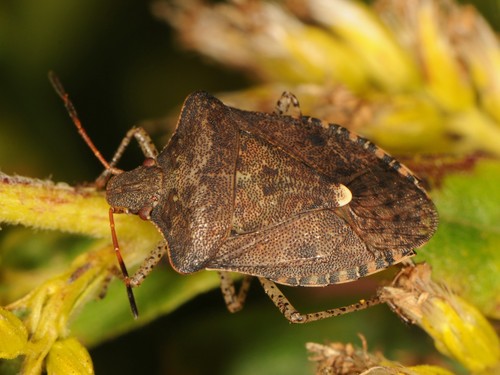
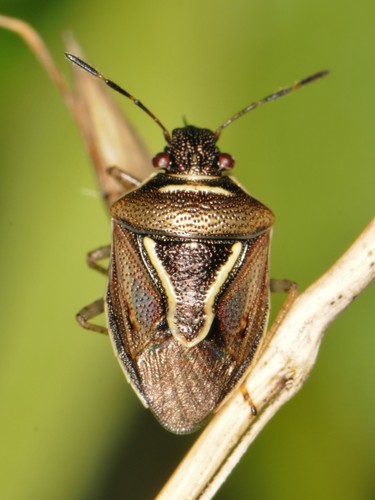
Mormidea lugens is a species of stink bug belonging to the family Pentatomidae, found in the Caribbean, Central America, and Eastern North America. In Illinois, adult Mormidea lugens have been observed emerging from overwintering sites in late April, and can be seen until early November. This species appears to be bivoltine, meaning it produces two generations per year, in this region. The eggs of Mormidea lugens are approximately 0.7 millimetres (0.028 inches) in diameter, pale yellow in color, and laid in small clusters that contain between 6 and 11 eggs, with a mean cluster size of 9.6. Adult Mormidea lugens are bronze-colored, with a white-yellow border around the scutellum, and measure 5.0 to 7.2 millimetres (0.20 to 0.28 inches) in body length. Under laboratory conditions held at approximately 24 °C (75 °F), development from the egg stage to the adult stage takes between 39 and 50 days, and this development time appears to be affected by the species of host plant the bugs feed on. Mormidea lugens has been recorded feeding on timothy, multiple species of sedges including Carex shortiana, C. amphibola, and C. normalis, deer-tongue grass (Panicum clandestinum), and Bosc's panic-grass (P. boscii). It has been collected from pale sedge (C. blanda) and wide-leaved spiderwort (Tradescantia subaspera), but feeding on these two species has never been observed. Deer-tongue grass also appears to be an insufficient food source to support nymph development to adulthood.