About Morinda citrifolia L.
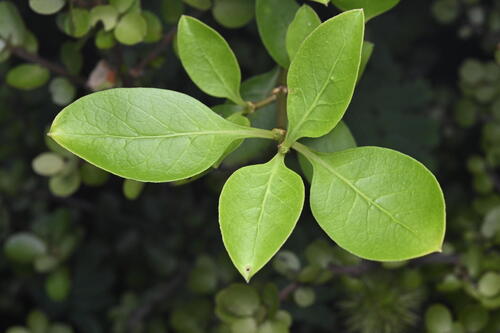
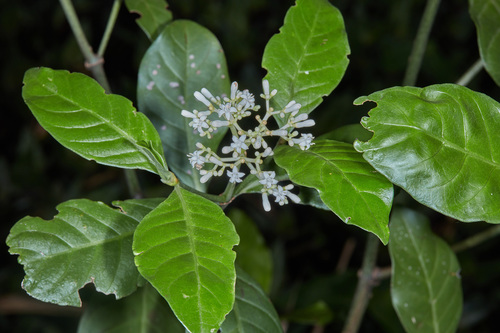
Morinda citrifolia L. is a shrub or small tree growing up to 6 metres (19 1⁄2 ft) tall, with grey-brown bark. Its twigs are roughly square in cross-section and often fleshy. Stipules are present; they are very broad, with an obtuse apex, and measure up to 2 centimetres (3⁄4 in) in both width and length. Its large, hairless leaves grow in opposite pairs on the twigs, reaching up to 25 cm (10 in) long by 13 cm wide. The leaves are elliptic to ovate in shape, with 6–9 pairs of lateral veins. Domatia (small structures) are usually present as dense tufts of hairs in the joints where lateral veins meet the midrib.
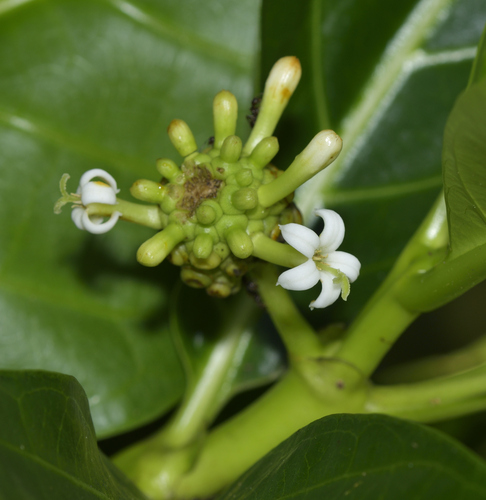
The inflorescences are dense flower heads that grow at the apex of branches. They are positioned opposite a leaf, replacing one leaf from an opposite pair. A single flower head may hold up to 90–100 flowers, but only a few open at a time. The flowers are white and tubular with five lobes, measuring about 15 mm long and across. The fruit is a multiple fruit made of fused drupes, each containing four seeds. Unripe fruits start green, then change through pale yellow to white or grey as they ripen; ripe fruits release a strong pungent odour similar to blue cheese. Fruits are irregularly ellipsoid or ovoid, and can grow up to 9 cm long by 6 cm wide.
This species is native to Southeast Asia and Australasia, and was spread across the Pacific by Polynesian sailors. It is now cultivated throughout the tropics and widely naturalized. Morinda citrifolia grows in shady forests as well as on open rocky or sandy shores. It takes 18 months for the plant to reach maturity, and produces 4 to 8 kg (8.8 to 17.6 lb) of fruit per month year-round. It is tolerant of saline soils, drought, and secondary soils, and can grow in a range of environments including volcanic terrains, clearings, limestone outcrops, and coral atolls. It can occasionally reach up to 9 m (30 ft) tall, and has large, simple, dark green, shiny, deeply veined leaves.
Morinda citrifolia flowers and bears fruit throughout the year, and it is common to see flowers and fruits at many different development stages on a single plant at any time.
In its ecology, Morinda citrifolia is attractive to weaver ants, which build their nests using the tree's leaves. These ants protect the plant from some plant-parasitic insects. The scent of ripe fruit also attracts fruit bats, which help disperse the plant's seeds. Drosophila sechellia, a species of fruit fly endemic to the Seychelles, feeds exclusively on the fruits of Morinda citrifolia.
A range of consumer products made from this species have been brought to market, including beverages such as juice drinks, powders made from dried ripe or unripe fruits, cosmetic products such as lotions and soaps, seed oil, and leaf powders used for encapsulation or pills. In traditional Polynesian cultures, green fruit, leaves, and roots or rhizomes may have been used as a general tonic, and the species was also used as a famine food. While Morinda citrifolia is attributed with beneficial biological properties in traditional medicine, there is no confirmed evidence of clinical effectiveness for any intended use. In 2018, the U.S. Food and Drug Administration issued a warning letter to a Hawaiian manufacturer of food and skincare products based on this fruit, for marketing unapproved drugs and making false health claims in violation of the U.S. Food, Drug, and Cosmetic Act.