About Morethia boulengeri (Ogilby, 1890)
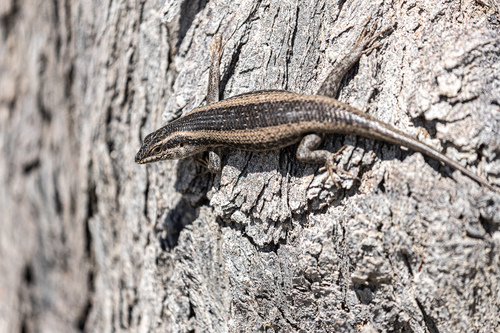
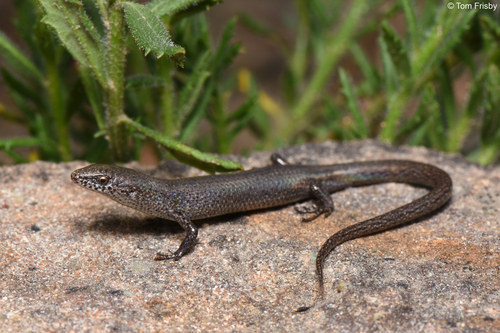
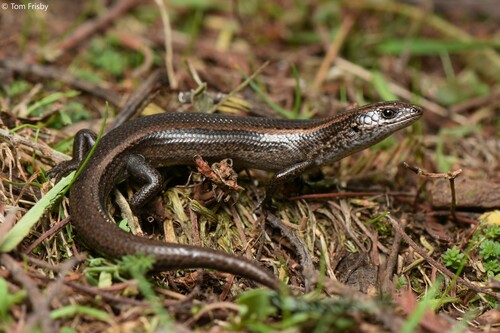
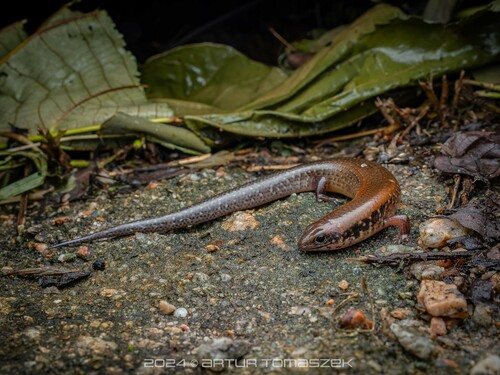
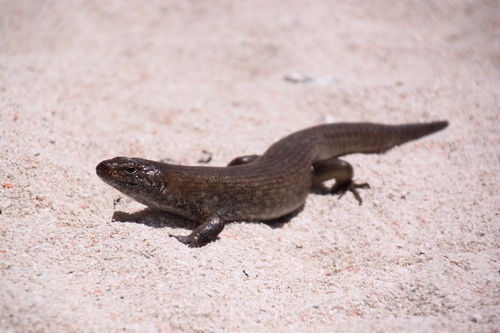
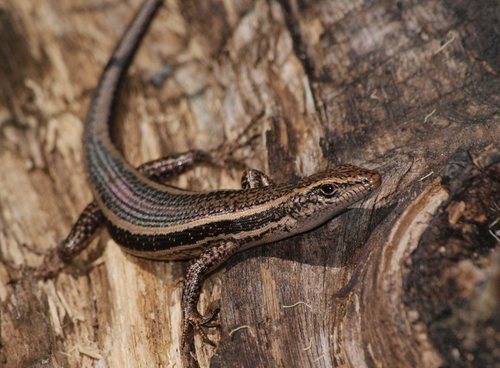
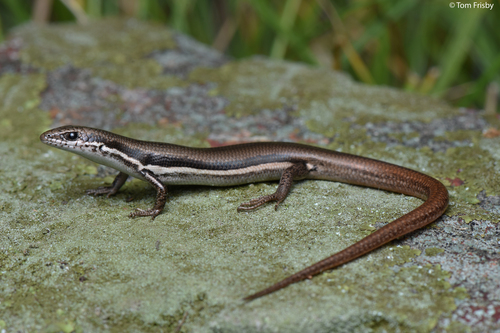
Markings and colouration of Morethia boulengeri vary significantly between individual lizards. In general, the species is grey or brown, with darker flecks arranged in a longitudinal pattern along its dorsal side, while its ventral side is mostly white. A thin white stripe also runs lengthwise from the mouth to the groin on both sides of the body; above this white line sits a thicker black stripe that borders it. Juvenile lizards have a distinctive red-orange tinge on the ventral side of their tail, a feature that distinguishes the entire Morethia genus. Boulenger's skink can reach a total length (including the tail) of 10 cm (3.9 in), but the average total length from nose to tail tip is only 8 cm (3.1 in), with an average snout-to-vent length of 4.5–5 cm (1.8–2.0 in). This skink species also has square-shaped supraciliary scales above the eye area. Morethia boulengeri is endemic to Australia, and occurs across most of the country, present in at least part of every Australian state and territory except Tasmania. It is a generalist species that can live in a wide range of environments in semi-arid and arid zones. It makes its home in leaf litter and dead fallen vegetation within dry sclerophyll forests, mallee, desert, scrublands, woodlands, and low shrublands. It is found in large numbers in the Murray catchment area of southern New South Wales, where population density can sometimes reach several hundred individuals per hectare. Mating for M. boulengeri takes place during the warmer months of spring and summer. During the breeding season, the throat of male skinks turns a vibrant orange at the same time that testicle size increases, which signals to females that the male is fertile and ready to mate. This skink species is oviparous, meaning females lay eggs. Females generally reach sexual maturity and begin breeding within their first year of life. On average, each clutch contains three eggs, and a single female produces roughly three clutches per year. Clutches incubate for approximately 60 days before eggs hatch, and oxygen consumption increases dramatically during this incubation period.