About Morella rubra Lour.
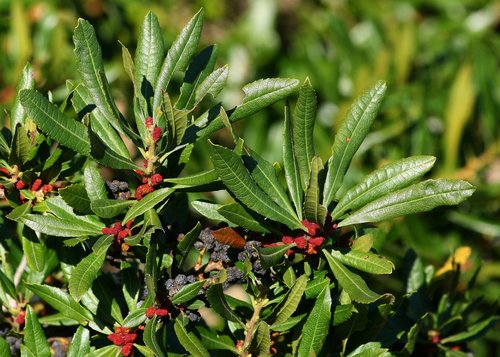
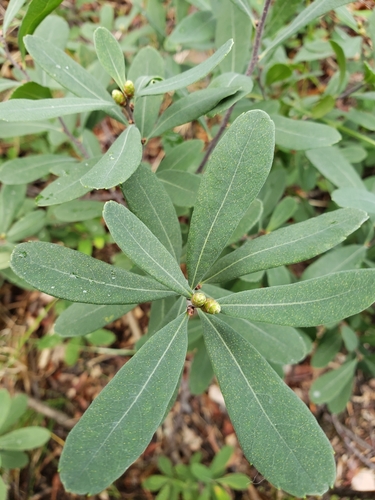
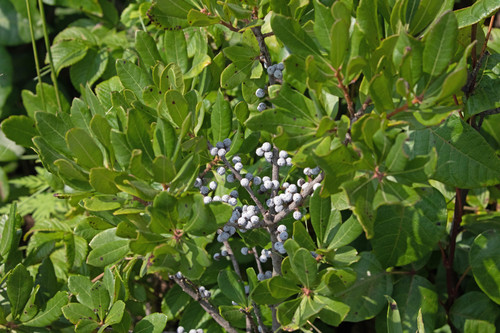
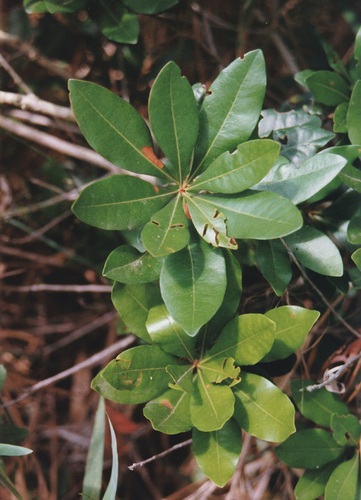
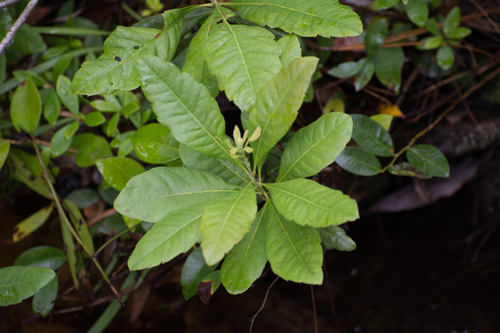
Morella rubra Lour. (also referred to as Myrica rubra) is an evergreen tree that reaches heights of 10 to 20 m (33 to 66 ft). It has smooth gray bark and a consistent spherical to hemispherical crown. Its leaves are leathery, hairless, and shaped elliptic-obovate to oval lanceolate; they are wedge-shaped at the base, rounded to pointed or tapered at the apex, with serrations along the full margin or just the upper half. Leaves measure 5 to 14 cm (2.0 to 5.5 in) long and 1 to 4 cm (0.39 to 1.57 in) wide, and are alternately arranged on branches, split into a petiole and leaf blade. The petiole is 2 to 10 mm (0.079 to 0.394 in) long. The underside of the leaf is pale green with sparse to moderate golden glands, while the upper surface is dark green.
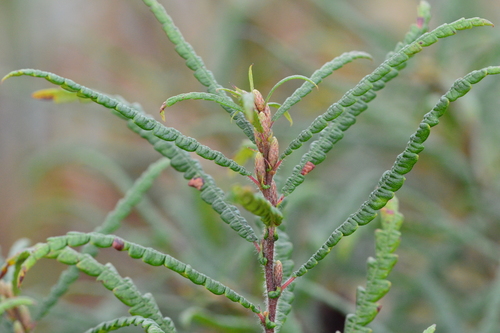
This species is dioecious. Male flowers, which have simple or unobtrusively branched bracts, are borne in inflorescences that grow individually or occasionally in small groups in leaf axils. Each male flower is accompanied by two to four egg-shaped, sparse lanceolate bracts, and contains four to six stamens with dark red, elliptical anthers. Female inflorescences grow as single multi-flowered spikes 0.5 to 1.5 cm (0.20 to 0.59 in) long in leaf axils. The inflorescence rhachis is hairy and glandular; overlapping bracts are hairless and only inconspicuously glandular. Female flower inflorescences are 1 to 3 cm (0.39 to 1.18 in) long, born on hairless stems, with nearly circular bracts around 1 millimeter in diameter that have golden glands on their underside. Each female flower is accompanied by four bracts. The superior ovary is covered in soft velvet-like hair, and has a style with a two-lobed stigma; the two slender stigma lobes are bright red.
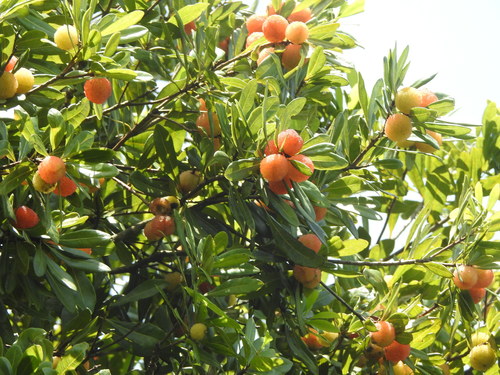
In China, the flowering period runs from March to April, and fruits develop from May to June. The fruit is spherical, typically 1.5 to 2.5 cm (0.6 to 1 in) in diameter, and may reach up to 3 centimeters in diameter. It has a knobby, thick-skinned surface that is usually crimson red, but can range in color from white to purple; the flesh is a similar or slightly lighter shade. A single seed sits at the center, with a diameter around half that of the whole fruit. The flesh is sweet and very tart.
This species is native to eastern Asia, where it occurs mainly in south-central China (in the provinces of Fujian, Guangdong, Guangxi, Guizhou, Hainan, Hunan, Jiangsu, Jiangxi, Sichuan, Yunnan, and Zhejiang), as well as Japan, Korea, and the Philippines. It grows in forests on mountain slopes and valleys at elevations of 100 to 1,500 metres (330 to 4,920 ft). Its seeds are dispersed by Japanese macaques and Yakushima macaques.
In China, cultivation is concentrated south of the Yangtze River, where the species has considerable economic importance and has been grown for at least 2000 years. It tolerates poor acidic soils, and has a root system 5 to 60 cm (2.0 to 23.6 in) deep with no obvious taproot. Myrica rubra was first introduced to the United States by Frank Nicholas Meyer, from seed purchased from the Yokohama Nursery Co. in Japan, and the introduction was published in the Bulletin of Foreign Plant Introductions in 1918. Plants from the introduction were grown and fruited in Chico, California and in Brooksville, Florida by David Fairchild. The University of Georgia Woody Plant Research Lab has introduced and researched this species since 2012; the lab's work covers propagation challenges, hormone signaling pathways during fruit development, and identification of new landscape cultivars for commercial and ornamental use. M. rubra is currently being commercialized in California by Calmei, a California corporation. Mature trees are prolific producers: a single tree can yield around 100 kilograms (220 lb) of fruit. As of 2025, tissue-cultured Morella rubra plants are available on the United States market. This is expected to significantly improve the yangmei industry in the United States by providing high quality container-grown plants, compared to the low survival rate risk associated with importing bare root plants. As of 2007, 865,000 acres were used for yangmei production in China, which is double the total acreage used for apple production in the United States. The tree is also used as an ornamental for parks and streets, and is a traditional tree used in classical East Asian garden design.