About Morella faya (Aiton) Wilbur
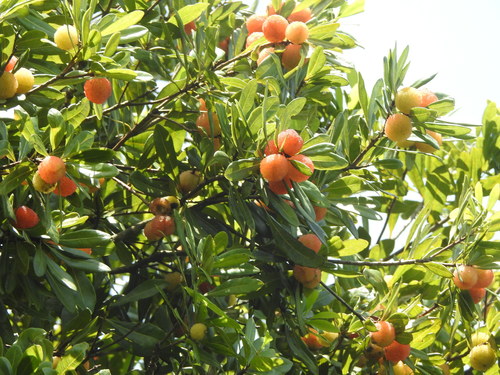
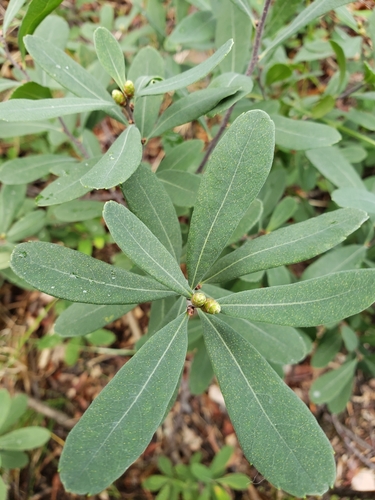
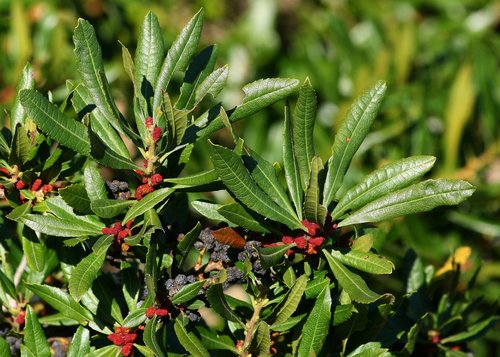
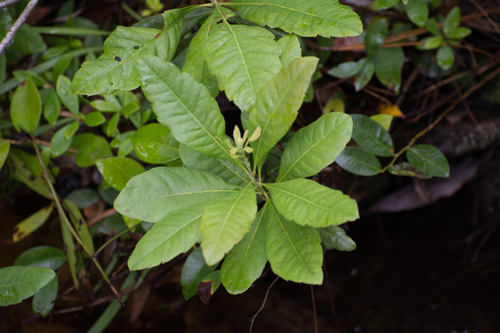
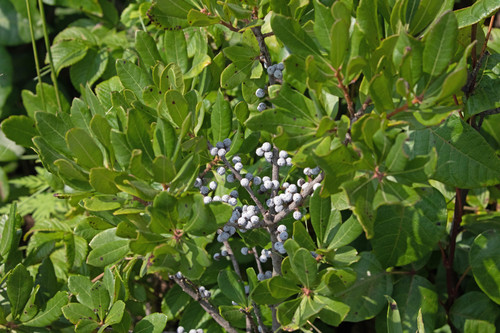
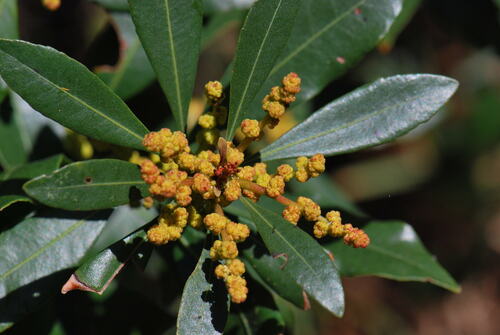
Morella faya (Aiton) Wilbur is an evergreen shrub or small tree that typically reaches 3 to 8 meters (9.8 to 26.2 ft) in height, and can grow as tall as 15 meters (49 ft) in rare cases. Its leaves are usually dark, glossy green, and measure 4–11 centimetres (1.6–4.3 in) long and 1–3 centimetres (0.39–1.18 in) wide, with smooth entire margins and a bluntly pointed tip. This species grows readily in any type of soil. It is subdioecious: male and female flowers are mostly produced on separate plants, but individual plants often bear a small number of flowers of the opposite sex (Binggeli 1997). Male flowers have four stamens, and are typically produced in dense clusters close to the branch. Female flowers usually grow in similar-sized groups, located slightly further from branch tips. Its fruit is an edible drupe 5–6 millimetres (0.20–0.24 in) in diameter. The drupe starts as reddish purple and ripens to a dark purple to black color. It is used as an astringent remedy to treat catarrh (Pérez 1999, Rushforth 1999). In Macaronesian islands, Morella faya is most abundant at altitudes between 600 and 900 meters. The population found in Continental Portugal may be native, or may be naturalized after early introduction from Madeira or the Azores (Rushforth 1999). It is an invasive species in Hawaii (Vitousek et al. 1987). In Hawaii, it displaces native trees such as Metrosideros polymorpha, and causes substantial changes to local nitrogen cycling (Vitousek & Walker 1989).