About Mopalia ciliata (G.B.Sowerby II, 1840)
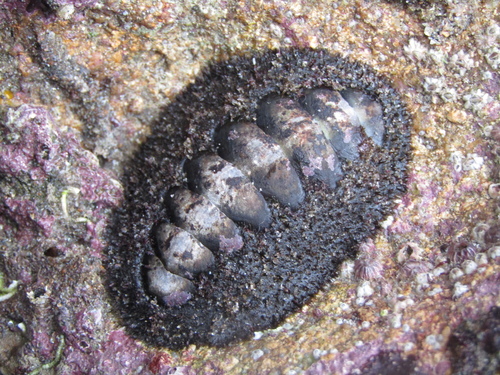
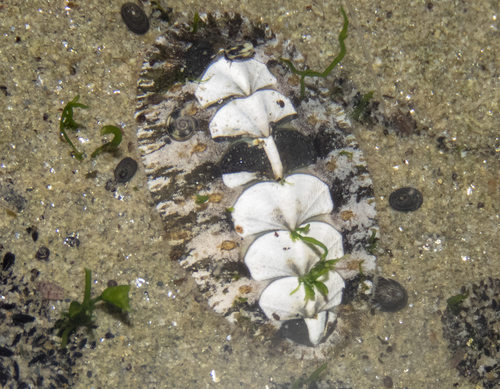
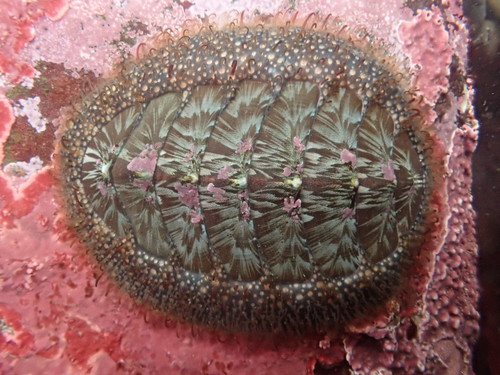
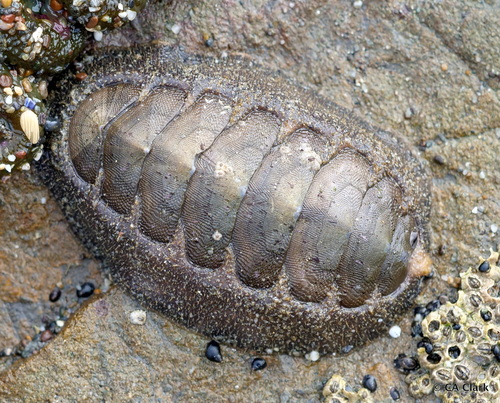
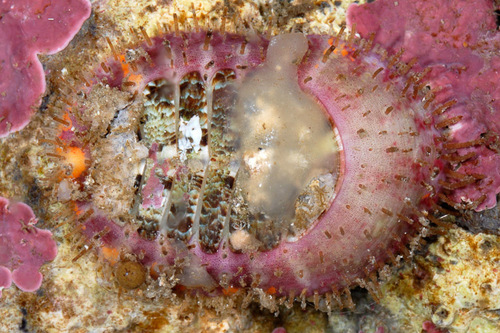
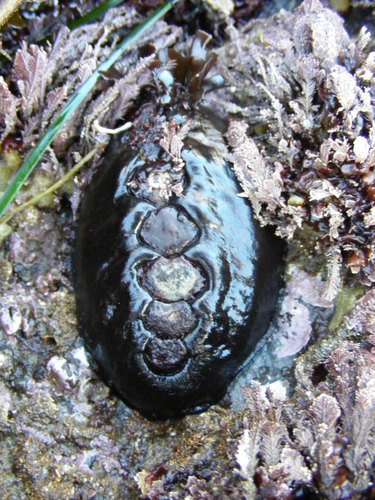
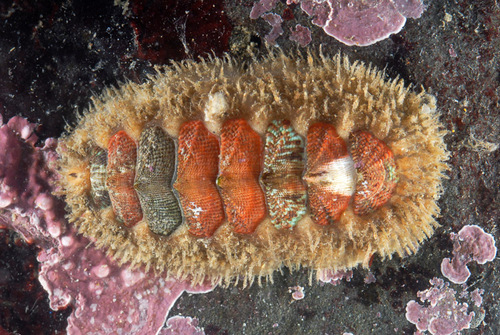
Mopalia ciliata (G.B.Sowerby II, 1840) displays the following morphological characteristics. For its valves: the individual valves are not always uniform in shape or texture. They can range from broad to narrow plates, and may be either smooth or coarse. All plates have a notch on their posterior end, and bear radial rows of pustules. The girdle measures between one-half and three-quarters the width of the valves, and is covered in spines formed from spiculed setae. When examined under a scanning electron microscope, the setae are very distinct. This species has flat, broad setae that carry rows of large, curved white calcareous spicules; these spicules reach up to 600 micrometers (0.024 inches) in length. The radula of M. ciliata is not highly distinct, and is proportionally 20% smaller than the radula of the closely related species M. kennerleyi. This species shares specific aesthete canal traits with M. spectabilis and M. swanii. Compared to other Mopalia species, which only have short extensions of their slit ray canals, M. ciliata has slit ray canals that extend over a wider distance and turn downwards toward the slit rays. A second shared trait among these three species is that their horizontal canals, which flank the jugal area, fan out laterally instead of running straight. The overall distribution of Mopalia ciliata is somewhat controversial. Researchers do agree that the species occurs along the southern coast of North America, extending as far south as Baja California. The presence of M. ciliata north of California is currently debated, as records from this region may instead represent the similar species M. kennerleyi. This species inhabits intertidal zones, where it is found on the undersides of rocks near cracks or crevices, and on other hard substrata.