About Montipora flabellata Studer, 1901
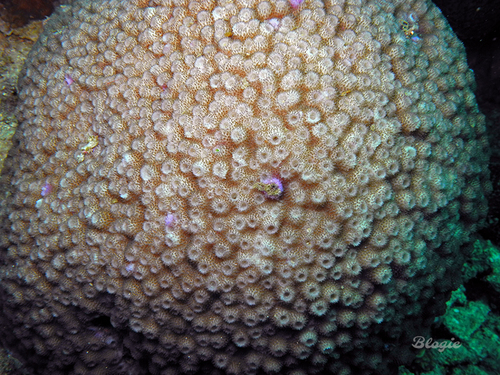
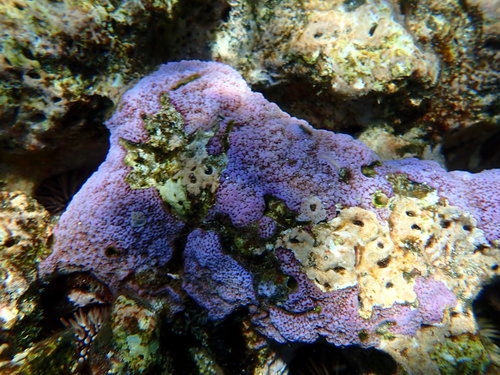
Montipora flabellata Studer, 1901 is a species of hard coral. Colonies are encrusting with irregular lobes, and their color is most commonly blue (which may photograph pink), but can also be brown, purple, lilac, or pink; fluorescent blue is only visible in photographs taken in sunlight. The colony surface is covered in papillae, which sometimes fuse into ridges. Corallites (calices) are small, with a diameter of 0.5 mm, and are immersed between irregular ridges of fused papillae. Septa are poorly developed. This species is endemic to Hawaiʻi and the Central Pacific. It is relatively abundant statewide in Hawaiʻi, with the highest predicted cover along the east coasts of Kauai and Oʻahu, and in wave-sheltered areas of Maui Nui. It occupies a very restricted ecological niche: it is found only in shallow water between 1 and 4 m depth, in environments with high wave energy, high water flow, and high UVR (ultraviolet radiation) exposure. It is common in shallow water exposed to surge, and prefers shores with high wave action, such as areas that experience winter 'big wave' surf. Montipora flabellata is currently under review for listing as a threatened or endangered species under the U.S. Endangered Species Act. This species is a broadcast-spawning simultaneous hermaphrodite that releases combined egg-sperm bundles. Unlike many coral species whose spawning is linked to the new moon, M. flabellata spawning does not appear to correlate with lunar phase cues. In monitored years, spawning occurred sporadically across most of the summer, with no clear lunar pattern. Temperature is the best seasonal predictor of spawning for this species. Gametogenesis (gamete development) has no clearly defined beginning or end, and development varies widely between and within colonies over a broad gametogenic cycle. M. flabellata maintains a diverse range of oocyte sizes and maturity levels year-round; the proportion of mature oocytes increases in midsummer and gradually declines into early fall, but large mature oocytes are always present. Testes mature alongside oocytes, and are also found in varying developmental stages throughout the year. Unlike oocytes, late-stage spermatocytes are not present in winter and spring.