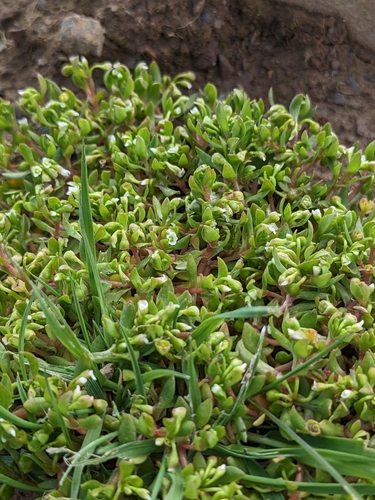
About Montia fontana L.
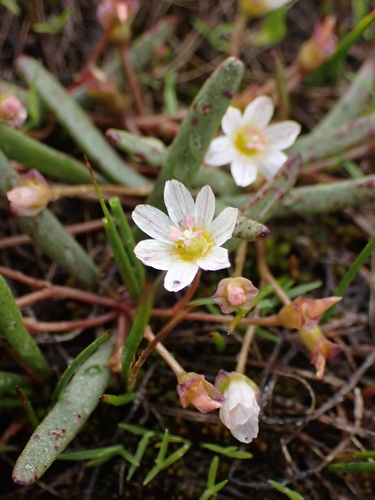
Montia fontana L., commonly known as blinks, is an annual to perennial prostrate herb with branching stems. It sometimes forms mats up to 50 cm across in short, seasonally damp grassland, or floats in streams and hollows. The thin stems are 0.5 mm in diameter, reddish, and sometimes root in water. Primary roots are fleshy and pink, with numerous secondary roots bearing fibrous hairs. Its spatulate leaves are succulent, glabrous, and arranged in opposite pairs, measuring 2–20 mm long and 1.5–6 mm wide, with a hydathode at the tip. On plants floating in water, leaves typically have a distinct petiole. For plants growing in dry grassland, mainly the subspecies chondrosperma, leaves narrow towards their base and fuse with the opposite leaf at the stem (this is called connation). The inflorescence is a terminal cyme of two or three tiny white flowers, each 2–3 mm in diameter, with five petals, two sepals, 3-5 stamens, and 1-3 styles each with one stigma. Fruit capsules are 2 mm in diameter and hold 3 round seeds. Seed structure is used to distinguish blinks' four subspecies. Blinks has an almost global distribution, and is considered native in most regions across all continents except Antarctica. It is only recorded as an introduced species in Venezuela and the Falkland Islands, and is absent only from southern Asia. Its global, European, and British threat status is LC (Least Concern). In Britain, it is common and widespread in the north and west, becoming scattered and rare towards the south and east. Despite being abundant, it is listed as an axiophyte in most British counties. Blinks grows in a wide range of wetland habitats, from permanently wet pools, springs and streamsides to winter-wet, sandy grassland. It mostly grows in acidic locations, but tolerates mildly alkaline conditions. In Britain, its altitudinal range extends from sea level to 996 m in Coire Leachavie, Glen Affric. Blinks flowers are either pollinated by insects or self-pollinate; self-pollination is especially common when flowers are underwater, as they are often cleistogamous in this setting. Its Ellenberg values in Britain are L = 7, F = 9, R = 5, N = 3 and S = 0, which indicates it grows in fairly sunny places with slightly acid, damp, low-nutrient soils, and it is not tolerant of salt. Under the European EUNIS habitat classification system, blinks is a characteristic species in three habitats covering four communities: C2.18 acid oligotrophic vegetation of spring brooks; C2.25 acid oligotrophic vegetation of fast-flowing streams; and D2.2C soft water spring mires, including D2.2C11 montane soft water moss springs. Within the British NVC classification, blinks, particularly subsp. fontana, occurs in several types of upland spring-fed vegetation, most characteristically M35 Ranunculus omiophyllus-Montia fontana rills. Mainly subsp. chondrosperma grows in summer-dry, rain-fed U1 Festuca ovina-Agrostis capillaris-Rumex acetosella grassland in sandy, more lowland habitats. Blinks is occasionally found in secondary populations in other habitats, such as woodland stream sides where it has presumably been washed, or on bowling greens or pavements after its original habitat is built over. In Scotland, the beetle Phaedon armoraciae chews on blinks leaves, and the smut-like ascomycete Tolyposporium montiae (Rostrup) Rostrup, 1904 can infest the root collar area. Larvae of the vinegar fly Scaptomyza graminum create leaf mines in blinks, and this association has been recorded in Britain and Europe. Blinks is edible; it is gathered from the wild and used as a salad vegetable in Spain and Portugal, but is not currently cultivated. It is high in fibre and a rich source of omega-3 fatty acids.