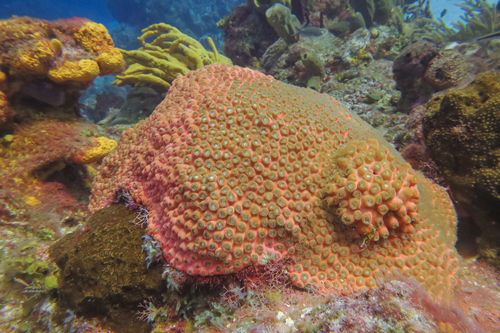
About Montastraea cavernosa (Linnaeus, 1767)
Great star coral (Montastraea cavernosa (Linnaeus, 1767)) forms massive boulder and dome-shaped colonies that reach over 1.5 m (5 feet) in diameter in shallow and moderate depth waters. In deeper waters, this species grows in a plate formation. It occurs across most reef environments, and is the dominant coral at depths between 12.2 and 30.5 m (40–100 feet). This coral sometimes displays a fluorescent red or orange color during daytime; recent research has proposed this color comes from phycoerythrin, a protein produced by cyanobacteria. It is thought that, in addition to symbiotic zooxanthella, this coral hosts endocellular symbiotic cyanobacteria that may help it fix nitrogen. However, a 2007 study by Oswold et al. found no functional phycoerythrin in M. cavernosa. This species is gonochoric, meaning each colony is either male or female, and spawns one week after the full moon in late August. Coral skeletons show sex-linked differences: female colonies have less dense skeletons than male colonies, which is likely due to females redirecting energy to egg production.

