About Montanoa atriplicifolia (Pers.) Sch.Bip.
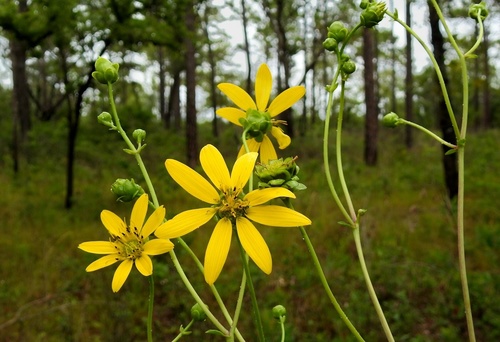
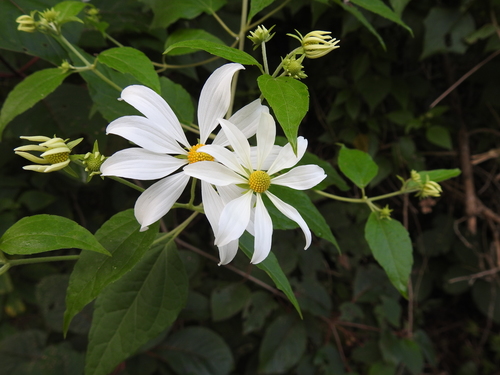
All roughly 29 species in the genus Montanoa are commonly called "daisy trees". This name comes from their attractive daisy-like flower heads, which have white petal-shaped ray florets and a yellow central "eye" made of disc florets. On their woody stems, leaves with clear petioles grow opposite one another. The most prominent and unique botanical feature of Montanoa atriplicifolia is found in its flower head (also called a capitulum): each yellow disc floret has a scale-like bract called a palea beside it. After the flower is pollinated, this palea grows significantly larger, forming a papery, net-veined, wafer-like structure that is widest near its straight (not curved) apex. This enlarged palea falls away together with the mature, much smaller, one-seeded cypsela-type fruits. Beyond this key feature, there are additional traits that separate Montanoa atriplicifolia from other daisy trees. When mature, the flower heads typically hang downward from stalks that do not have low, flat ridges of blade tissue called "wings" along their sides. The number of disc florets per head ranges from 85 to 120. The corollas of the yellow disc florets are notably small, only about 2 millimeters (roughly ⅛ inch) tall, while the petal-like corollas of the ray florets measure 12 to 24 millimeters (roughly ½ to 1 inch) long. Especially in Mexico's Yucatan Peninsula, Montanoa atriplicifolia can grow as a highly branched vine. In other regions at higher elevations and in wetter environments, it more commonly grows as a shrub. Montanoa atriplicifolia is native to Chiapas (Mexico's southernmost state) and Mexico's Yucatan Peninsula, and ranges south through Central America into Costa Rica. In Mexico's Yucatan Peninsula, Montanoa atriplicifolia grows in coastal scrub, multiple types of low-growing tropical deciduous forest (including those that host columnar cacti), and disturbed areas. The photographs featured on this page were taken from an individual growing in an open treefall area on limestone bedrock in forest adjacent to the Chichén Itzá Ruins in Yucatán, Mexico. In Nicaragua, Montanoa atriplicifolia is a characteristic species of disturbed areas and rocky, nutrient-poor soils that are undergoing desertification. In Mexico's Yucatan Peninsula, Montanoa atriplicifolia is known to provide nectar for honey production, and it is used as a floral offering in religious settings. Within Mayan communities of Mexico's Yucatan Peninsula, Montanoa atriplicifolia is used both as an ornamental plant and as a stimulant.