About Monstera deliciosa Liebm.
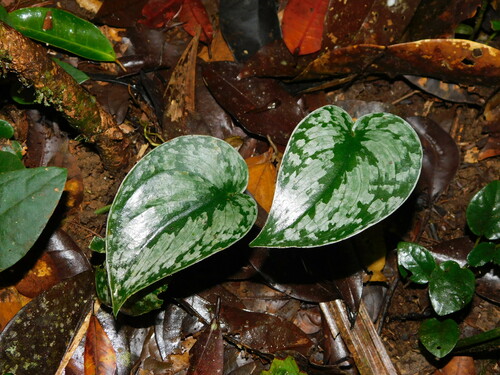
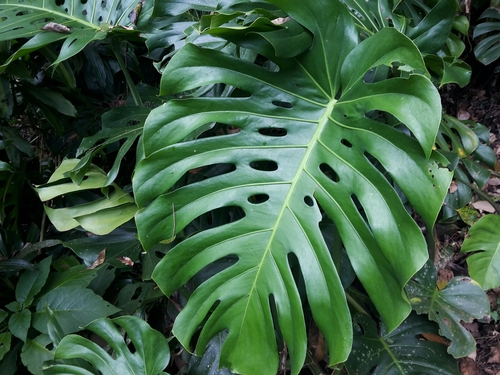
Monstera deliciosa Liebm. is a hemiepiphyte in the arum plant family (Araceae) that grows with aerial roots. In its natural wild habitat, it can reach up to 20 m (66 ft) in height. It produces large, leathery, glossy, pinnate, heart-shaped leaves that measure 25–90 cm (10–35.5 in) long by 25–75 cm (10–29.5 in) broad. Leaves on young plants are smaller, entire, and have no lobes or holes; as the plant grows, it quickly develops lobed and fenestrate leaves. Older plants produce leaves with more of the species' characteristic large perforations. While wild plants can grow very tall, indoor cultivated plants only reach between 2 and 3 m (6.6 and 9.8 ft) in height. The exact function of leaf fenestrations remains unclear, and three main theories have been proposed: that they increase water absorption, limit wind damage, or reduce negative impacts from herbivores. Wild seedlings grow toward the darkest area they can reach until they find a tree trunk, then begin growing upward toward light, creeping up the tree. This species produces inflorescences covered by a uniform, cream-white velvety spathe that forms a hood over a yellowish white spadix. The spadix is 10 to 15 cm (3.9 to 5.9 in) high and around 3 cm (1.2 in) in diameter. Monstera deliciosa flowers are self-pollinating, as each flower contains both male androecium and female gynoecium reproductive structures. This plant is native to humid tropical forests in lowlands and middle mountains, found growing wild in extreme southern Mexico, plus Belize, Honduras, El Salvador, Nicaragua, Costa Rica, Guatemala, Cuba, and Panama. After seeds fall to the ground, seedlings display negative phototropism and crawl until they encounter a tree to attach to. The plant's many adjacent roots let it anchor to its new host tree and reach canopy light; wild plants rarely grow in full sun, and prefer dim light filtered through tree foliage. Wild populations of the plant have also been recorded in other regions: Florida (North America), Malaysia and India (Asia), Australia, and locations across the Western Mediterranean and Atlantic: Sicily, mainland Portugal, Morocco, and Madeira. Monstera deliciosa is moderately toxic to both cats and dogs, because it contains needle-like insoluble calcium oxalate crystals. These crystals can cause injury to the mouth, tongue, and digestive tract, and direct contact with cat or dog skin causes dermatitis. Monstera deliciosa is commonly grown as an outdoor ornamental plant in tropical and subtropical regions. It requires a large growing space and rich, loose soil; a mix of equal parts garden soil and compost is ideal. When planted in open ground, it grows best near a tree it can climb, or alternatively against a trellis. It is described as a moderately greedy plant, and only needs watering to keep soil slightly moist. Its hardiness rating is 11, tolerating a minimum cold temperature of −1 °C (30 °F); it cannot withstand this temperature for more than a few hours, but can survive outdoors in certain temperate regions such as the Mediterranean coast and Brittany. A steady minimum temperature of at least 13–15 °C (55–59 °F) is preferred to support continuous growth. Growth stops when temperatures are below 10 °C (50 °F), and frost kills the plant. It needs very bright light exposure, but not full direct sun. Forcing flowering outside the species' native tropical habitat is difficult, and specific growing conditions are required for it to flower. In its native tropical and subtropical habitat, however, the plant flowers easily, and typically flowers about three years after planting when grown in ideal conditions. It can be propagated by taking cuttings from mature plants, or by air layering. Its structured foliage form, easy cultivation, and tolerance for a wide range of growing conditions also make it an ideal plant for indoor cultivation. Because of these traits, it is a popular plant for homes and offices across the temperate northern hemisphere. For indoor growth, it prefers bright indirect light and temperatures between 20–30 °C (68–86 °F). It is usually watered when the soil has dried slightly, which occurs after roughly one to two weeks. It requires well-draining, peat-based soil to thrive, such as mixes that include perlite and bark pieces. Flowering is rare when the plant is grown indoors. In the United Kingdom, both the standard species Monstera deliciosa and its cultivar 'Variegata' have been awarded the Royal Horticultural Society's Award of Garden Merit. In regions where the species grows naturally, the mature fruit of M. deliciosa is considered a delicacy with a sweet, exotic flavor. Fruit is harvested for ripening when it is still green, cut from the plant once the first scales begin to lift and the fruit starts to exude a pungent odor. The cut fruit is wrapped in a paper bag and stored until its scales begin to pop off. Scales are then brushed off or fall away to reveal the edible flesh underneath. The texture of the flesh is similar to pineapple, and it has a fruity flavor similar to a mix of jackfruit and pineapple. Unripe green fruits irritate the throat, and latex from the plant's leaves and vines can cause skin rashes; both unripe fruit and plant latex contain potassium oxalate, which is why fruit must only be consumed after scales begin to lift. Irritant black fibers can be brushed off the flesh by applying a small amount of citrus juice. The species' aerial roots have been used as ropes in Peru, and to make baskets in Mexico. In Martinique, the root is used as a traditional medicine to treat snakebites. In Mexico, the root is used in traditional medicine to relieve arthritis symptoms.