About Monotoca glauca (Labill.) Druce
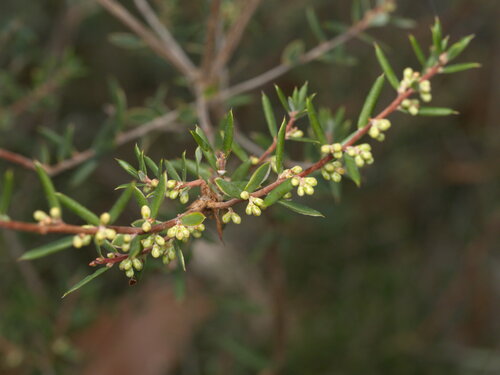
Monotoca glauca (Labill.) Druce is an evergreen, densely branched shrub or small tree with slender branches, that typically grows 2–3 m tall. Its leaves are similar to those of Cyathodes glauca, but do not grow in whorls. Venation is characteristically spreading or palmate, which is a defining feature of the Monotoca genus. The leaves are elliptic with a pointed tip, and usually measure 1.5 cm long. The upper (adaxial) leaf surface is yellowish-green and glabrous, while the lower (abaxial) surface is glaucous. Flowers are pentamerous, white, and grow solitary in axillary spikes. M. glauca is usually hermaphroditic, but sometimes produces unisexual flowers through abortion of pollen or ovules. The corolla tube is short, with spreading lobes. Flowering occurs in January and February. The fruit is an ovoid drupe that is green when mature, and measures 3mm in diameter. While Monotoca elliptica is superficially very similar to M. glauca, it can be distinguished by its terminal spikes, and its leaves are typically wider and less linear.
In terms of distribution and ecology, Monotoca glauca is a common understory shrub found at the edges of wet eucalypt forests, mixed forest, buttongrass moorlands, and in logged areas. It occurs more commonly west of Tyler's Line. This species is hardy to most frosts and light snowfalls, and tolerates moist, shady sites. It is susceptible to Phytophthora cinnamomi, and is intolerant of phosphorus. It may grow on fertile loam, as well as poor and well-drained soils.
In cultivation, Monotoca glauca is an ideal hedging plant. It can be grown from cuttings or seed, but requires good drainage and part to full sun. Monotoca species have particularly low seed germination success, and the Royal Tasmanian Botanical Gardens seedbank has made a concerted effort to determine the germination requirements for this genus.