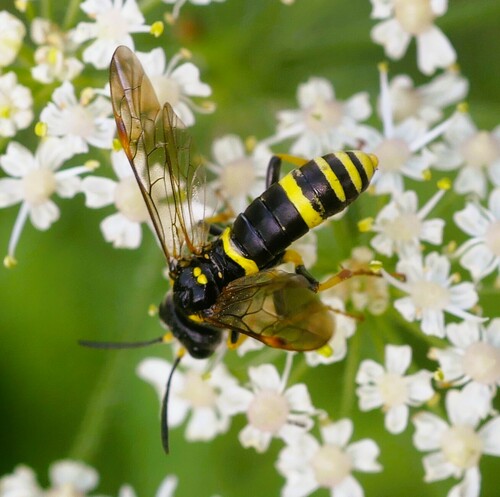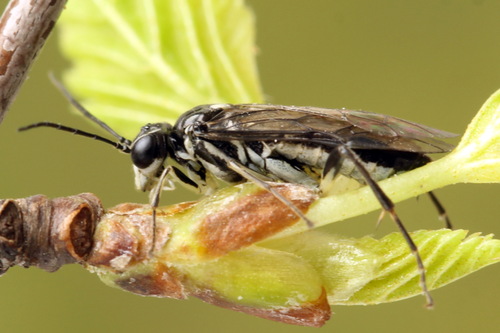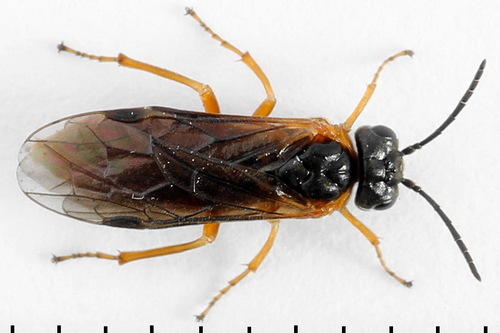
About Monostegia abdominalis (Fabricius, 1798)
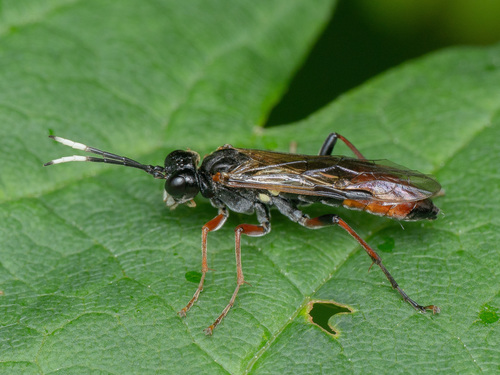
Monostegia abdominalis (Fabricius, 1798) can be described by its life stages as follows. Adult individuals have black heads and thoraxes, with yellow markings that include the mouthparts. Their legs and abdomen are mainly yellow, and their wings are suffused with brown. Eggs are smooth, white, and oblong, measuring 1 mm by 4 mm. Larvae are caterpillar-like, and grow from 2–4 mm long when young to 16–21 mm long at maturity. Pupae are shorter and fatter, measuring 8 mm in length, and become increasingly melanized as they develop. This species has a holarctic distribution. In its native range, it extends from Europe south to Asia Minor and the Caucasus, and east through Siberia. It was introduced from Europe to North America in the 1950s, where it naturalized, and its range there continues to expand. In 1979, its North American range stretched from Quebec to New Jersey, and west as far as Ontario and Ohio; by 2016, it had also been detected as far west as Washington in the United States, and across Canada from Alberta to the Maritimes. This species has two to three generations per year, called bivoltine for two generations and multivoltine for three generations, with the number of generations depending on the length of the local summer season. Some larvae overwinter; non-overwintering larvae mature in July, burrow in soil, and emerge as adults in August. Overwintering larvae that remain in soil through the winter pupate in spring and emerge as adults in June. This species is thelyotokous, meaning females develop from unfertilized eggs, and males are very rare. Newly emerged females land on the underside of leaves near the top of their host plant. Each female carries 30–70 eggs, which she deposits over roughly one week, then lives for approximately one additional week after finishing egg-laying. The female uses her ovipositor to penetrate host plant leaves, and deposits eggs into the cavity she creates, usually two eggs at a time. She moves from the distal end of the leaf toward the stem, forming an egg cluster that contains between 6 and 16 eggs. Eggs are laid directly on host plant leaves. First-instar immature larvae stay with their egg cluster for one day before dispersing to feed on the undersides of leaves. A single larva can consume an entire host plant, and will migrate to a new plant after completely defoliating its current one. When larvae reach the sixth instar, they are mature; they stop feeding, drop to the soil, burrow into the ground, and pupate.