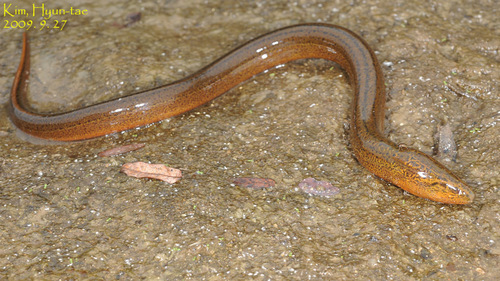
About Monopterus albus (Zuiew, 1793)
The Asian swamp eel (Monopterus albus) has a scaleless, eel-shaped (anguilliform) body that reaches one meter or less at maturity, with most adults measuring 25 to 40 cm long. It has a tapering tail, blunt snout, and completely lacks pectoral and pelvic fins. Its dorsal, anal, and caudal fins are underdeveloped, and the caudal fin is often absent entirely; these small fins help prevent the eel from rolling, and assist with making sudden turns and stops. The eel’s gill membranes are fused, with a single V-shaped gill positioned under the head, a shape that prevents water from flowing backward through the gills. Body color varies between individuals, but is generally olive or brown with irregular dark flecks. Eels found in Florida usually have dark bodies and heads, with dark olive or brown coloring on their dorsal (upper) side and light orange coloring on their ventral (lower) side. Florida individuals may also be more brightly colored, which suggests they were originally bred for the pet trade. The eel has a large, protractile mouth, and both its upper and lower jaws are lined with tiny teeth. It feeds on fishes, worms, crustaceans, and other small aquatic animals. Monopterus albus has a broad distribution. It is native to most of East and Southeast Asia, ranging westward into India, and occupies tropical and subtropical regions from northern India and Burma east to China, Japan, and the Indo-Malayan Archipelago. Populations reported from Far East Russia and northeastern Australia likely belong to separate cryptic species, and are not considered part of the native range of M. albus. It is a common fish across India, from southern China to Malaysia and Indonesia. Most populations in Japan (on the islands of Honshu and Kyushu) are probably introduced from China, while the population in the Nara Basin was introduced from Korea in the early 20th century. The species’ discontinuous distribution across Japan further supports that it was introduced within the last roughly one thousand years. Eels found in Taiwan are split between two distinct species: a Japanese form introduced in the 1940s, and a common Southeast Asian form that may be either introduced or native. Asian swamp eels were first introduced to Oahu in the Hawaiian Islands around 1900, and still occur there today. The earliest record of the species in the Philippines dates to 1918, from a collection held by the Commercial Museum of Philadelphia, and the species is now an invasive in the Philippines. Asian swamp eels did not colonize locations in the Southeastern United States until the end of the 20th century. Around 1990, the eels were introduced to several ponds at a nature center near Atlanta, Georgia, within the Chattahoochee River drainage basin; by 1994, individuals had moved into an adjacent marsh at the Chattahoochee Nature Center north of Atlanta. Soon after, eels were collected from Florida waters in 1997 at two widely separated sites: one in southeast Florida, and the other in west-central Florida. Tens of thousands of Asian swamp eels are estimated to live along nearly 55 miles of two water canal systems in southern Florida: one in the North Miami area, and another on the eastern edge of Everglades National Park. Two additional populations have been discovered in the region since 1993: one outside Tampa, Florida, and another in southern Georgia near the Chattahoochee River. At least some of these North American populations are thought to have originated from intentional or accidental release from home aquariums or fish farms. Some local residents may also have deliberately introduced the eels to establish them as a local food source. The Asian swamp eel prefers a wide range of muddy, shallow freshwater wetland habitats, including rice paddies, ditches, ponds, marshes, streams, rivers, canals, lakes, and reservoirs. It thrives best in water less than 3 meters deep. M. albus can survive across a wide range of water oxygen levels, and can obtain up to 25% of its required oxygen from air through its skin when it cannot use its gills underwater. M. albus is a nocturnal species. Its diet includes other fish, shrimp, crayfish, frogs, turtle eggs, and aquatic invertebrates such as worms and insects, and it occasionally eats detritus. An older 1958 document claimed M. albus can move across dry land, but many years of study have found no evidence to support this claim. The species serves as an important source of protein for people in Thailand, and is widely cultured across Vietnam. Across Indonesia, Cambodia, China, Laos, Myanmar, Thailand, Vietnam, and other Asian countries, swamp eels are farmed in polyculture with rice crops, and sold as food alongside the rice harvest. On Bali, where the eel is called lindung in the Balinese language, it is sold dried in nearly all village markets for use in Hindu religious offerings. In Japan, the species is called ta-unagi, a name derived from the words ta (meaning paddy) and unagi (meaning eel), it is usually written as タウナギ in katakana, and is not commonly eaten there. In addition to its use as food, this eel species is often released into natural water bodies in Thailand. This practice follows Thai traditional belief that releasing the eel will help end suffering and sorrow, and earns religious merit, similar to the release of other aquatic animals like climbing perch, striped snakehead, Chinese edible frogs, and pond snails.