About Monodonta labio (Linnaeus, 1758)
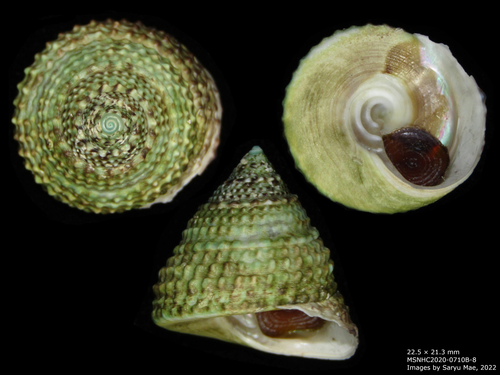
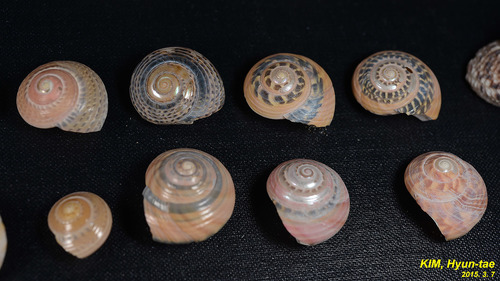
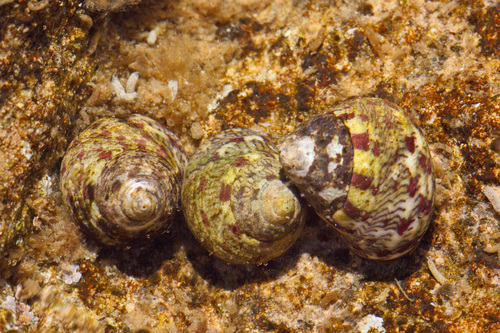
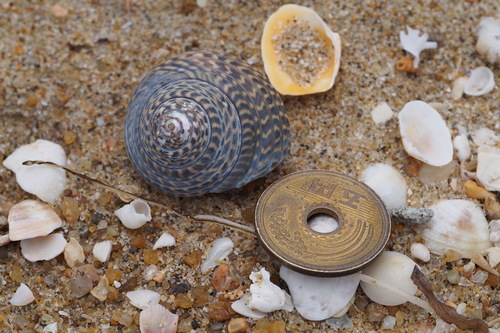
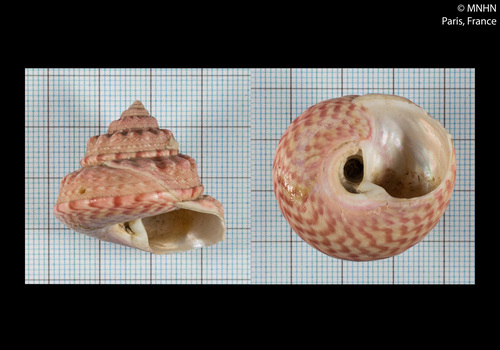
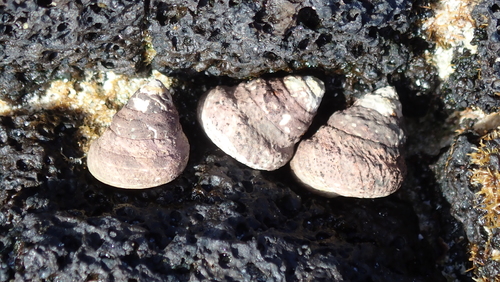
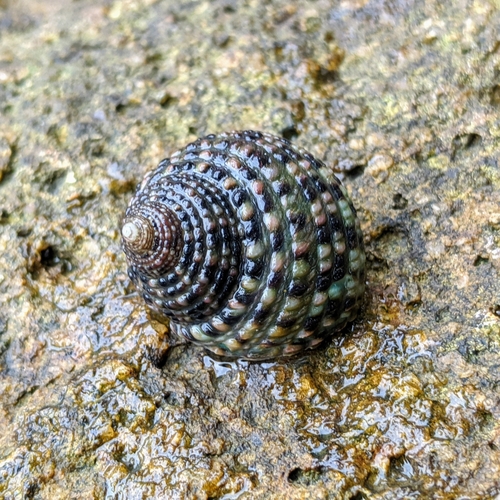
Monodonta labio (Linnaeus, 1758) has a shell that ranges in length between 15 mm and 45 mm. The shell is heavy, coarse, and has a rough, grained surface. It has moderate sutures between its rounded whorls: the body whorl is swollen, while the penultimate whorl is somewhat less swollen. The shell features a rounded keel, which is a spiral ridge that marks a change of slope, and an umbilicus sealed with a callus. In adult individuals, the apex is often worn away. The columella bears a prominent, blunt tooth, and the inner edge of the outer lip has a number of smaller knobs. The interior of the aperture is nacreous. Shell color varies from dark reddish brown to pale brown, marked with spiraled dashes of cream or pink. This marine species is distributed across a wide range: it occurs in the Central and East Indian Ocean, the Western Indian Ocean from the Persian Gulf to Madagascar and the Mascarene basin, Indo-China, Indo-Malaysian Oceania, the Philippines, Micronesia, the Western Pacific, and northern, western, and northeastern Australia (Northern Territory, Queensland, Western Australia). It is also commonly found near the tide line in Hong Kong. This snail inhabits the lower intertidal zone, where it lives on or under rocks and coral, though it can tolerate a wide variety of substrata.