About Monodacna colorata (Eichwald, 1829)
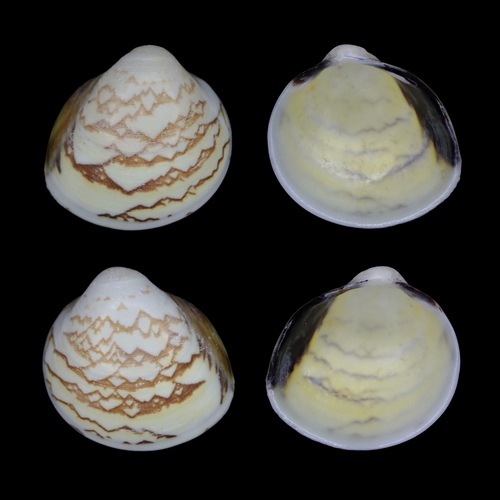
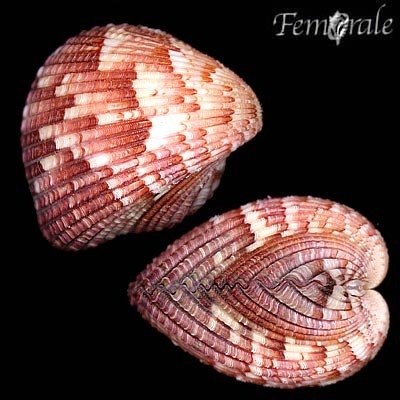
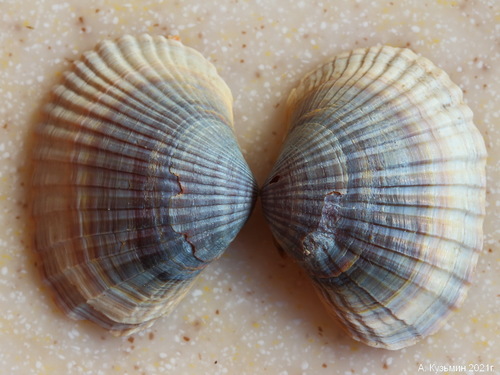
Monodacna colorata (first described by Eichwald in 1829) has a broadly oval, rather thin, moderately convex shell with a low umbo. The shell bears 21–36 oblique triangular radial ribs and a shallow pallial sinus, which may extend up to slightly over one-third of the shell's total length. The maximum shell length is 40 mm (1.6 in), maximum height is 32 mm (1.3 in), and maximum convexity is 19 mm (0.75 in). The shell valves gape noticeably at the posterior margins, while the anterior gape is often weak. Shell coloration ranges from whitish, yellowish, and pinkish-white to reddish-brown or grayish-lilac, with thin grayish-green periostracum and colored concentric bands. The internal shell color matches the external color, but is more saturated. The hinge of each valve holds a single, variably developed cardinal tooth. The closely related species Monodacna pontica differs from M. colorata by having rounder ribs and less vivid coloration.
M. colorata is native to freshened areas and limans of the Black Sea and the Sea of Azov. Its confirmed native localities include lakes Kagul, Yalpuh, and Kugurlui, the Razelm-Sinoe Lake complex in the Danube Delta, the Kuchurgan, Dniester and Dnieper-Bug limans, Taganrog Bay, Mius Liman, the Don Delta, and the Kirpilsky, Kurchanskiy, Konovalovskiy, Kulikovskiy, and Polyakov limans of the Kuban Delta and Temryuk Bay. The species was once present in Brates Lake, but became locally extinct there in the 20th century due to land conversion. It disappeared from Tiligul Liman after a canal connecting the liman to the Black Sea increased water salinity. In the early 20th century, M. colorata was abundant in Berezan Liman, but has since disappeared from some localities in this area, which has not been fully surveyed. In Yeysk Liman (Sea of Azov), M. colorata was last recorded in the 2000s, and subsequently went locally extinct due to salinization and eutrophication. It was recorded in Akhtanizovsky Liman (Kuban Delta) in the early 20th century, but has not been found there in later surveys. Empty shells of M. colorata have also been found in Lake Varna and Black Sea littoral sediments in Bulgaria, but it is unclear whether these come from 20th century populations that went extinct after the lake became more saline, or from older Holocene or Late Pleistocene occurrences.
M. colorata has been introduced to several areas outside its native range. It was deliberately introduced to the Veselovsky Reservoir on the Manych River between 1951 and 1956. It was first recorded in the northern Caspian Sea, off the Volga Delta, in 1959, and most likely arrived there via ships after the opening of the Volga–Don Canal. It has since spread into the Volga Delta itself, Dnieper River reservoirs, the lower course of the Don, Tsimlyansk Reservoir, the Karpovskoye, Bereslavskoye and Varvarskoye reservoirs of the Volga–Don Canal, and the Volgograd, Saratov and Kuybyshev reservoirs of the Volga, as well as the Bolshoy Irgiz River. M. colorata was deliberately stocked in the Kuybyshev Reservoir between 1965 and 1970, and did not initially establish there, but later invaded Volgograd and Saratov reservoirs, and has been recorded in Kuybyshev Reservoir since the start of the 21st century. Introduction attempts to the Aral Sea in 1964 and 1965 were not successful. Within the Black Sea Basin, M. colorata became abundant in Sasyk Lake, which was converted from a marine habitat to a brackish water reservoir after a canal connected it to the Danube in 1978. In Kazakhstan, M. colorata was intentionally introduced to Lake Balkhash in 1965 and Kapchagay Reservoir in the 1970s, and has since spread to other local water systems including the Irtysh–Karaganda Canal.
M. colorata inhabits fresh and slightly brackish water, where it lives on soft sediments at depths up to 8–12 m (26–39 ft). It occurs in waters with a salinity of 0.03–7‰, but can survive short periods at salinities of 12–16‰. It is a burrowing filter feeder that consumes diatoms from genera including Navicula and Coscinodiscus, as well as detritus. In its native habitats, M. colorata forms communities with Dreissena mussels, or with the brackish water cockles Adacna fragilis and Hypanis plicata. These mixed Adacna-Hypanis communities had disappeared by the 21st century due to severe declines of A. fragilis and H. plicata, though large populations of both M. colorata and A. fragilis still persist in Taganrog Bay. In the lower Volga, M. colorata is found alongside freshwater mussels from the genera Unio and Anodonta. In the northern part of Tsimlyansk Reservoir, M. colorata has become a dominant species alongside the introduced subspecies Adacna vitrea glabra.
M. colorata typically reaches sexual maturity at two years of age, when it reaches a shell length of 10 mm (0.39 in). Three-year-old specimens with a shell length of 20 mm (0.79 in) are considered fully adult. The breeding season runs from late April to September. Females produce approximately 200,000 eggs total, and release between several dozen and 50–70 eggs at a time. At water temperatures of 11–24 °C, development from embryo to veliger larva takes one day. The veliger larvae settle to the bottom after 14–30 days. An unidentified species of trematode is known to parasitize M. colorata.
M. colorata has been intentionally introduced to many non-native water bodies to serve as an additional food source for commercially important fish. It is consumed by fish species including Azov roach (Rutilus heckelii), common bream (Abramis brama), sturgeons, and Clupeonella larvae. M. colorata itself is also considered edible for humans.