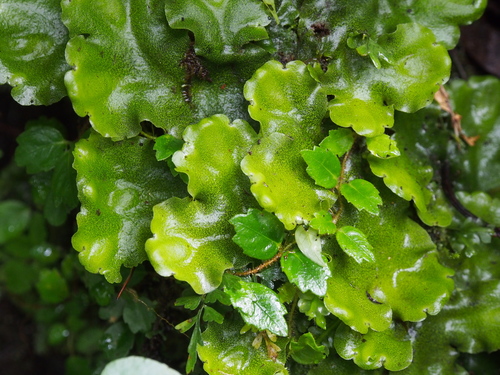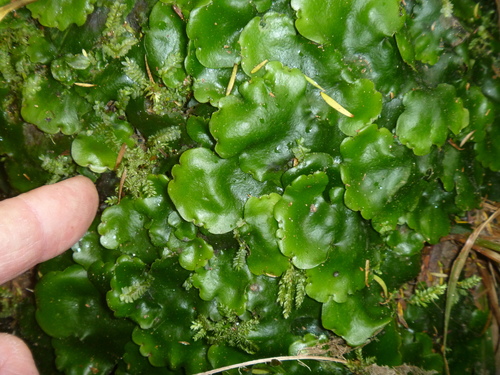
About Monoclea forsteri Hook.
Monoclea forsteri Hook. is one of only two species that make up the thallose liverwort family Monocleaceae. This species was formally described by Hooker in 1820, and its holotype is held at the British Museum. It is dioicous, and its capsule splits open through a single longitudinal slit when dehiscing. Endemic to New Zealand, it is widely distributed across the country, including the subantarctic Auckland Islands, and it is the largest thalloid liverwort native to New Zealand. It commonly grows near streams, and can also be found throughout a variety of damp habitats. Because this species is dioicous, local populations can consist of a mix of male and female plants, or be entirely single-sex. Morphology of this species does not change when it grows in different environmental conditions. However, plants that experience regular submergence are very often sterile.