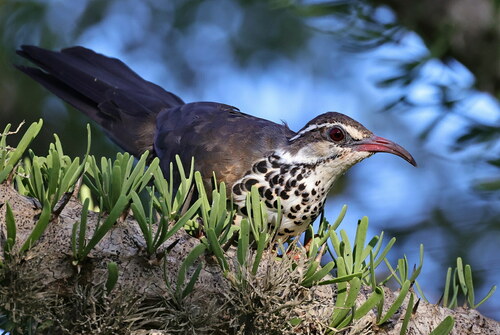
About Monias benschi Oustalet & G.Grandidier, 1903
The subdesert mesite (Monias benschi Oustalet & G.Grandidier, 1903) is a medium-sized terrestrial bird, often described as resembling a rail. It can be distinguished from other members of its family by its long, downward-curved bill. Both sexes have greyish upper plumage and thin white eyebrows, and both have white underparts. Males have black crescent-shaped spots on the sides of the neck and upper breast. Females have rufous spots that may merge into a general rufous tone, along with a tawny cheek patch.
This species is restricted to spiny thicket with open areas, ranging from sea level up to an altitude of 130 m (430 ft). It only occurs in a coastal strip 200 km (124.3 mi) long and 30 to 60 km (18.6 to 37.3 mi) wide, located between the Fiherenana River and Mangoky River in south-western Madagascar. There is roughly 2,500 km² (965 sq mi) of still-suitable habitat north of Manombo; habitat outside this area is becoming increasingly fragmented.
Subdesert mesites forage by picking invertebrates, seeds and fruit from the ground, and may dig into the ground surface. Their nests are exposed twig platforms built in bushes within 2 m (6.6 ft) of the ground. Females lay one or two eggs, and both sexes share incubation and care of the young. This species may be polyandrous or polygynous. The birds live in communal groups, and give a loud "nak! nak!" alarm call when disturbed.

